China: Currency

June 2014 (by Pat)    Itinerary Link
china-money

CURRENCY

Before I get to that, though, and because I don’t know who, if anyone, will read this, I thought I’d give a little background information.

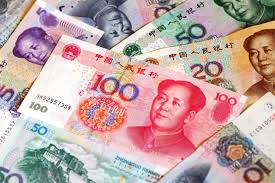
The unit of the Chinese currency is the yuan, also known as RMB or by the measure word kuai. It was worth a little over 16 cents at the exchange rate I was getting. All bills of 1Y and up have a portrait of a young Mao.

While most countries have replaced small denomination bills with coins, China has not. There are one yuan and one jiao (a jiao is a tenth of a yuan) coins, but they are not common (there is also a one jiao note.) Commerce is conducted in bills. As a result, the small denomination bills, one, five, and ten, are exchanged a lot and tend to be crumpled and dirty. They’re also small. When I get them in change, I tend to shove them into my pocket and treat them as small scraps of paper. They’re spent without thought and disappear quickly.

The largest bill in general circulation is the 100Y note. It is big and pink and, generally, clean. That, plus the big 100 that they display, makes them feel like big money. If I spend two at once, I feel like a spendthrift, never mind the fact that they’re each worth just a bit over $16 each.

China tightly controls its money exchange. As a consequence, there is little variation in exchange rates from place to place as you can find, for example, in Europe. The actual act of exchanging money, however, appears to have become more complicated than I remembered.

In Xi’an, I was getting low on cash and the ATM, where I usually get local currency, was not cooperating, so I needed to exchange actual dollars. I first went to a hotel with a money exchange sign outside. They told me to go to the Bank of China and pointed me in a direction. I came to a different bank, went in there, and they said Bank of China. I then came to one of the major banks and went in there and they took my dollars and passport and told me to sit down, it would be about 20 minutes. This seemed silly, so I took my money and passport back and continued on to the Bank of China.

At the Bank of China, I was told I needed to fill out a money exchange form, get a number, and wait for a teller. When I got to the teller, I handed him the form, five $20 bills and my passport, which I knew would be necessary. He asked me how much I wanted to exchange and I said $100. He said that I didn’t need the form and handed it back to me. He then proceeded to examine each of the $20 bills minutely, front and back, tilting each one up to look for the watermark. Next, he paged through my passport two times and made a copy of the front page. He then pulled out one of those four part tissue paper forms that are ubiquitous in China, handed it to me and asked me to fill in my name, nationality and passport number and hotel information. Next,he tore the form into its constituent parts, filed three and put one aside for me. He then told me the exchange rate. I said fine. He then removed 6 100Y notes from the till and ran them twice through the counting machine, then proceeded to count them twice. He then told me how much money I was going to get, which, coincidently, was exactly 100 times the rate he had already quoted. I again said fine. He then pulled out some additional small bills, wrapped the whole bunch up in the tissue paper receipt and handed the package to me, saying that according to form I should get an additional fen (a fen is one-tenth of a jaio) but he didn’t have any. I said ok. Total elapsed time – about 15 minutes.

Nothing is ever simple in China.

Chongqing(China): 1N/2D

June 2014 (by Pat)    Itinerary Link

CHONGQING

Chongqing is one of four special municipal districts in China. It has a population of 30 million. Chiang Kai Sheck made it his capital after the Japanese drove him out of Nanjing. The dense fog that hangs over the city protected it from Japanese bombers. It is a mountain city. Lots of steps. Little level ground. Very difficult to get your bearings. We discovered the bearing issue very quickly.

We left the Yangtze cruise ship on Thursday the 12th and went on the city tour and to the lunch offered. After lunch, we left the group and caught a cab to our hotel. After settling in for a bit, we decided to head for a central square and look for a railway ticket office near there. It was not quite a mile away and I thought it would be nice to walk there and explore the city along the way. This proved to be a mistake.

I had looked up walking directions, but, before long, we found ourselves in a long automobile tunnel. Emerging from the other side, we saw no streets, just various expressways. We did see a bus stop turnout and crossed over to it to get a bus headed in the general direction we wanted. As soon as we got on the bus, it turned onto a bridge over the river in exactly the opposite direction of what we wanted. We got off the bus, found a cab and the driver managed to bring us to the square.

My walking directions more or less worked from there and we eventually found the ticket office. We were buying tickets for three separate train trips planned for the coming days. YK gave the agent the itineraries, he rang it up and then asked for our passports. China is crazy for passports. You need your passport for the strangest things. I had mine, but YK did not have hers. No tickets. As we walked away, she remembered she had a photocopy. We went back, he accepted the photocopy, and we got the tickets.

The next adventure was getting back to the hotel. I thought it would be easy. We hailed a cab and showed the guy the hotel information. He puzzled over it and said something to us in Chinese. We just pointed back to the hotel info and he eventually took off. After a while, it became clear something was wrong. It was taking too long, the trip was only a mile or so, and we seemed to be going to the wrong area. I tried to point this out to him, but, by then, he had picked up another passenger, a young woman, who was getting his attention. After a while, he pulled over and seemed to indicate that our hotel was “over there.” I was just glad to get out of the cab.

Of course, our hotel wasn’t there. We found ourselves on a wide pedestrian street or mall with many high-end shops – Armani, Cartier, etc. We explored for a while and then found a cab which successfully brought us to the hotel.

The specialty cuisine of Chongqing is hot pot and YK had found a hot pot restaurant she wanted to try. We took a cab to the restaurant and, after dinner, walked around and found ourselves in the same area we had been dumped in the afternoon. It was there that YK fulfilled one of her goals for the trip – buying a 10Y watch.

It was the next day, as we traveled to Gongtan, that the adventure really began.


5-Day Yangtze River Cruise: Wuhan to Chongqing(2) – The Cruise

June 2014 (by Pat)     Related Itinerary    continuing from part (1)

china-wuhan

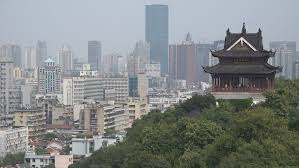
WUHAN

We were up early anyway. We had breakfast at the hotel and then went looking for a railway ticket office we knew to be nearby. According to the hotel clerk, it opened at 8. We explored the area for a while and came to the ticket office at 8. There was a woman waiting there, so we knew we had the time more or less right. Nonetheless, by 8:15, the office had still not opened and we had to head back to the hotel to catch our bus. We would have to get our train tickets for the post-cruise trip in Chongqing.

Wuhan is a city of 10 million and is, I believe, the largest city in central China. A local tour guide talked about the city as the bus took us to the Wuhan museum, which was big and modern and boring.

After an hour or so, we were taken to lunch and then to our ship.

THE YANGTZE RIVER

The Yangtze is the third longest river in the world. The Nile and the Amazon, however, flow for much of their length through uninhabited areas. The Yangtze River Valley, on the other hand, is home to over 350 million people, one-third of China’s population. It has long been responsible for periodic devastating floods and flood control was of the three reasons given for the construction of the Three Gorges Dam.

THE THREE GORGES DAM

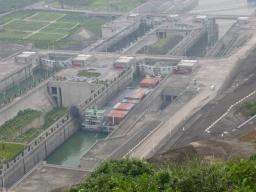
The dam was first proposed by Sun Yat Sen at the turn of the twentieth century. It was completed in 2012 and is the largest hydroelectric facility in the world. The construction of the dam was quite controversial as it resulted in the flooding of many villages and potential historical archeological sites. More than one million people were relocated.

The ship locks:

china-3gorgesDam

THE CRUISE

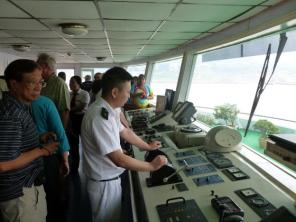
The cruise was upstream from Wuhan to Chongqing. It was as promised, but a bit odd. It was sort of like an imitation cruise, the Chinese idea of what a cruise should be. There was the captain’s champagne reception. The captain was a tiny man who had been sailing the Yangtze for over 30 years and seemed puzzled that he now had passengers. There was a “specialty restaurant” offering, for $50, a two course “western style” meal. I don’t know of anyone who tried it. There was entertainment. One night the crew performed. Another night, theoretically, the passengers were to perform, but only one act volunteered.

china-yangtze-aptain

The room was quite comfortable with a balcony. The food was buffet style and not particularly good. YK commented that for once we wouldn’t have to worry about overeating on a cruise.

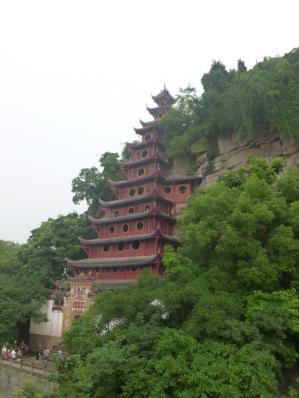
We had a “shore excursion each of the four full days of the cruise. We toured Youyang, a city of 5 million, took small boats up the “Goddess Stream,” a small tributary, toured the Three Gorges Dam and visited a 12 story wooden pagoda. We stood on deck as the ship entered the first of the five locks used to move ships between the upstream and downstream water levels.

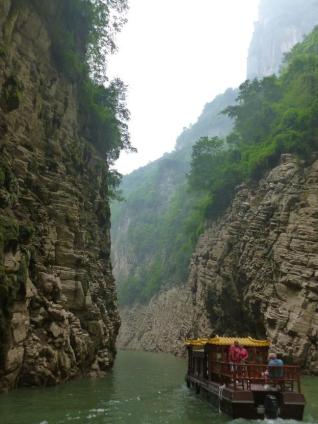
The Goddess Stream:

china-yanhtze-godessStream

There was beautiful scenery, especially when sailing through the gorges. It was always somewhat foggy, however, a condition common to the Yangtze River Valley. This condition persisted for most of the trip, even after leaving the river proper.

The Shibaozhai Pagoda:

china-yangtze-pagoda

On the last night, as our tour guide Maggie was explaining the logistics of our 8AM flight from Chongqing to Beijing, we took her aside and told her that we would not be going back to Beijing but would stay in central China. When she realized we were staying in Chongqing, she invited us to join the Chongqing tour and lunch that another group was going on the next morning. It was very nice of her.

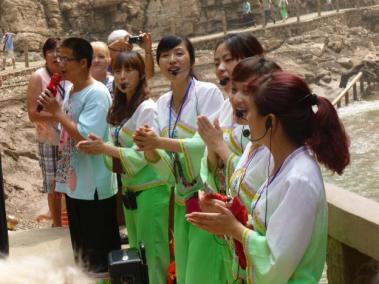
 The Local Guides:

china-yangtze-localGuides

This slideshow requires JavaScript.