Fenghuang(China): 1N/2D

June 2014 (by Pat)    Itinerary Link


PHOENIX ANCIENT TOWN

Our next destination was Fenghuang, also known as Phoenix Ancient Town as the name refers to the mythical bird. This is another town with a long history, but bigger and more popular than Gongtan. We encountered many Chinese tour groups there.

The plan was – bus to Youyang, the closest town with a train station from Gongtan, train to Tongren, then bus to Fenghuang. It happened pretty much as planned with a couple of glitches at the beginning and end.

We had inquired about the bus when we arrived in Gongtan and were pointed to a yellow bus on the road above the hotel. When we asked about the schedule, we were told, “whenever there’s enough people.”

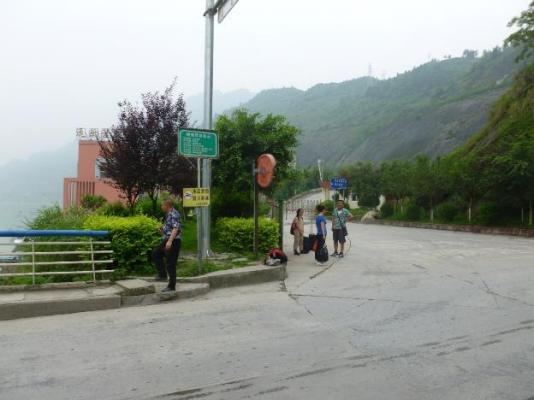
The next morning, there was no yellow bus on the road. We went up to the road and waited at the spot we thought we had seen the bus the day before. Nobody around. After about 15 minutes, someone came down the road and we asked about the bus. We were directed up the road and eventually, and around a bend, we came to an area with a couple of shops and a couple of mini buses, one of which was what we wanted. But it wasn’t yellow.

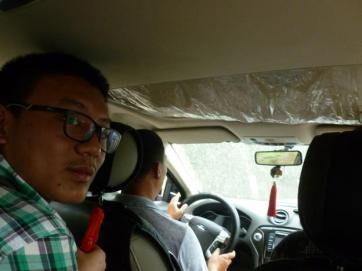
When we arrived in Youyang, we hailed a cab to take us to the train station. We started off and I noticed the driver hadn’t started the meter, but I thought he had said the fare would be 15Y which seemed reasonable. I repeated the number to be sure and learned not 15Y, but 150Y, which seemed way out of line. We said no, got out of the cab and retrieved our luggage.

With the next cab, we asked the fare before getting in. He said 100Y. It occurred to us then that the train station may not be right in the town as we had expected.

It wasn’t. It was a good 30 to 40 minutes outside of town. The fare was still high, but he got us to the station on time.

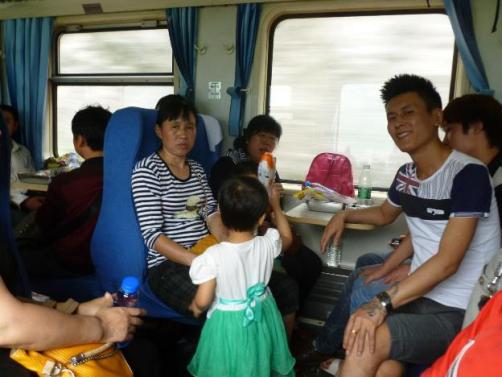
Once again, the train was crowded and we had to eject people from out seats.

It was on this train ride that I saw the fish for the second time. But this time there were children and grandmas. The grandmas bought the fish for the kids and the kids loved them. I noticed at that point that the fish had wheels and would scoot around on a table or the floor and YK noticed that the tune it was playing was Gangnam Style. I decided to buy one for my granddaughter Emy, but, when the vendor returned, there were no more fish. The grandmas had bought them all. The vendor was now selling a toy airplane, but I wanted the fish.

There would be one more train ride on our trip, however, so I held out hope for the fish.

china-fishOnTheTrain
the fish

Once in Tonren, we found the bus to Fenghuang fairly easily, but, when we arrived there, the cab driver didn’t know where our hotel was and, when he called the phone number we had for the hotel, he got a message that the phone was disconnected. He took us to the general area and we started wandering around and asking. Eventually, I stayed with the luggage and sent YK off down a long crowded alley where she eventually found the hotel.

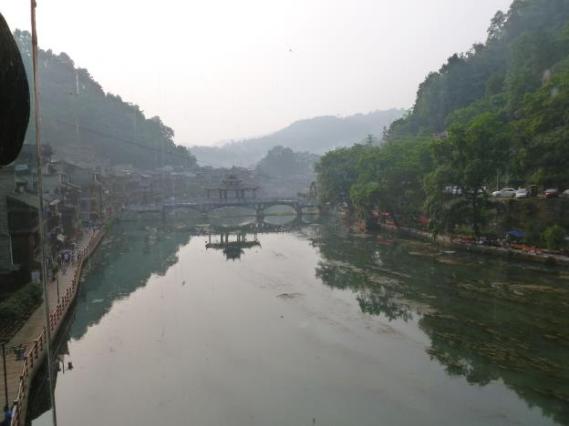
The room proved to be wonderful – spacious, fully equipped bathroom, floor to ceiling window and small balcony overlooking the river running through the center of town. The town itself was charming, though, unlike Gongtan, bustling with Chinese tourists. We bought several boxes of the spicy ginger candy for which the town is known.

phoenixtown-windowView

phoenixTown-sign

JISHOU

Our next destination, Jishou, was basically a way station and we were in no hurry to leave Fenghuang. We stayed for lunch and the hotel clerk not only called us a cab, he carried our bags across the river (no cars can reach the hotel,) told the driver to take us to the bus terminal and told us the fare (20Y.) After an unnecessary stop at the ticket counter (you pay on the bus,) we found our bus and were off to Jishou. The only problem was that we didn’t know when to get off the bus and overshot our hotel by quite a bit. A cab driver was happy to bring us back, however. Not much interesting in Jishou.

Gongtan(China): 1N/2D

June 2014 (by Pat)    Itinerary Link

gongtan1

GONGTAN

YK had carefully planned an itinerary that would take us to various interesting places. Our first goal was Gongtan, a 1700-year-old village on the Wu River(Wujiang in Chinese), a tributary of the Yangtze. Some years ago the village was scheduled to be flooded by a dam on the Wu. To avoid this destruction, the residents moved the town, brick by brick, to a safe location.

YK could find no information on travel to Gongtan on any English language website, so she enlisted the help of a friend in China. The plan was: train from Chongqing to a town called Pengshui, bus to a boat dock outside of town followed by a two hour boat journey on the Wu to Gongtan. It didn’t work out that way.

Even finding the train proved to be a problem. Our cab let us off in an underground cab area. Following signs upstairs, we found ourselves in a large cavernous and fairly empty hall, part of which was locked off as if it hadn’t opened yet. There was no sign of any train activity and no directions to trains. After wandering around the hall for a while, we noticed a building next door that seemed to have activity and went over there. It housed the ticket counters, but there was still no sign of actual trains. We returned to the first hall, again saw nothing happening, and eventually went outside, in the rain, and explored further, finally finding the entrance to the station in a third building. We then got on what proved to be, for some reason, the wrong security line, but eventually we found our train.

The train was already packed. We ejected people from our seats. I then fought my way down the aisle, eventually finding storage space for our luggage on the overhead rack. We then settled for the 2 1/2 hour ride to Pengshui.

china-train-sleep

It was during this ride that I first saw the fish. In addition to a snacks and drinks vendor and a fruit vendor, there was a toy vendor roaming along the crowded aisles. The toy vendor was holding an orange plastic fish with flashing lights inside, playing a jingle, and wagging its tail. I remember asking YK who would buy such a thing on a train and she said maybe a father returning from a business trip.

When we arrived in Pengshui we had a rather long walk, up and down flights of stairs, to a small parking lot full of cars and minibuses. We were accosted by a rather aggressive gentleman who was intent on taking us somewhere and, before long, our bags wound up in his minivan. YK drew a picture of a boat and he seemed to understand, but it was not clear that he was taking us there, but wherever he was taking us would cost 10Y each. As more passengers got into the van, it became clear that we were headed into town.

When we arrived in town and the other passengers had left, he indicated that he would take us somewhere else for an additional 4Y each. We thought at first this might be the boat dock, but, when, we tried to clarify, we learned the boat dock would be 70Y. We gave to him 8Y to see where he would take us and he took us to the bus we wanted.

The driver of the bus was a somewhat chunky middle aged woman with dyed blond hair and a skirt that didn’t quite cover everything it was supposed to. She came over to us, we told her where we were going, she understood and told us the fare would be 4Y. We then waited for the bus to fill up, eventually heading out of town. After about 20 minutes, she pulled over and told us this was where we were to get out.

We walked down to the river, found the boat, boarded and then were told that the boat was not going to run that day because there weren’t enough passengers. [I found this youtube video showing what we missed]

This presented a major problem. We were in the middle of nowhere, along a country road with little traffic, didn’t speak the language, and had no idea how to get anywhere.

Fortunately, we had saviors. There were three other ejected passengers, a couple and their high school age son. And the boy spoke some English. He said we would have to try to catch a bus to Gongtan. I had no idea if there were buses to Gongtan or how one caught one, but was glad to be around people who seemed to know what they were doing. I learned later that the buses stop anywhere along the road, but only if they have empty seats and the buses that went by us were all full.

china-stranded
waiting for a miracle

After 30 or 40 minutes, a car passed us and stopped a bit down the road. The father went and talked to the driver and the driver offered to take us all to the next town. When we got there he arranged for a hired car to take us the rest of the way. We were saved.

china-hitchhiking

Of course, we didn’t have a hotel reservation. YK had used a site called Agoda to book our hotels, but nothing in Gongtan has a web presence(finally found this 6 years later.) We followed the family to their hotel and asked for a room. We were given several to choose from. The cost for one night was 100Y.

The accommodations were, to say the least, rustic. No towels, soap, shampoo or toilet paper and a squat toilet.

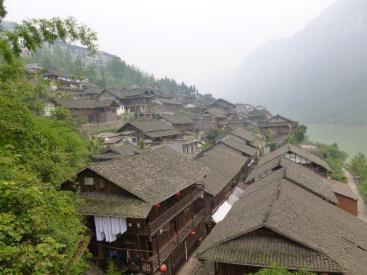
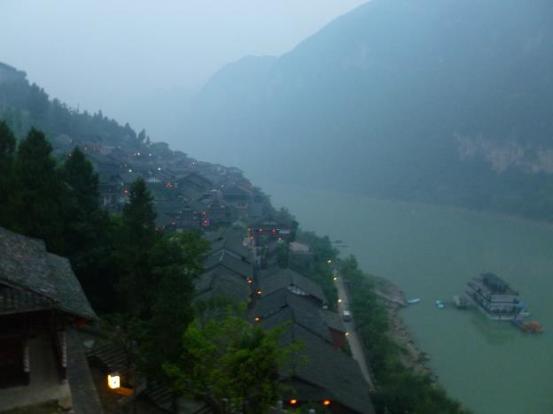
But the view from the porch was gorgeous, overlooking the village and the river to the sheer cliff on the far bank.

We walked around the village for a while, then returned to the hotel where the proprietor served the five us dinner on the porch. I remember thinking that this was the first place I had been in China that seemed peaceful. As it grew dark, music and singing emerged from the one bar and echoed back to us from the far cliff.

gongtan2

China: Transportation

June 2014 (by Pat)    Itinerary Link

china-transport

TRANSPORTATION

During our 5 day trek from Chongqing to Xi’an we used several different modes of transportation. Here they are.

Train – Trains in China are cheap, crowded, uncomfortable and, usually, late. We took three different train trips of 2+ hours each. The total cost for the six tickets was about $27. Most of the time we were in three across bench seats facing three other people in three across bench seats. The aisles were full of standees and luggage. We were lucky to have reserved seats.

Inter Urban Bus – These are large busses, with luggage compartments underneath. They operate out of depots and you buy a ticket at a counter. They run on expressways and are generally comfortable.

Inter Town Bus – I’m not sure what to call these things, but they were the dominant form of transportation on the roads we were traveling. They are minibuses, sitting 10 to 15 people. There’s no luggage compartment underneath and no marked starting and stopping location. There’s a driver and a money collector who collects the fare on the road. They run on rural roads and passengers get on and off anywhere along the road.

We were traveling on mountain roads and the most unnerving thing about these buses was the driver’s willingness to pass on blind curves as long as he tooted his horn once to tell any potential oncoming traffic to get out of his way. I’m surprised I didn’t see wrecks of these things scattered along the roads.

china-busontheroad

Taxi – Cab drivers tend to be very honest, sometimes to a fault. All the cabs are metered and, in the big cities, the meter is always used. In some of the smaller towns, where the initial flag drop can be as low as 3Y, the meters are not used, but a price is announced up front. For instance, in the town outside Zhangjiajie National Park, it was understood that any cab ride was 10Y. The drivers always said this up front and I had no problem with it.

I was surprised to see that in some towns the meter registered fractions of a yuan. In one instance, the meter read 18.3. I handed the driver 19Y and exited the cab. He called YK back and handed her a 1Y note. He wasn’t going to let us overpay. In another instance, in Xi’an, the meter read 13 and I handed the driver 15. He went through his wad of bills and could find no 1Y notes, so he gave me back 5Y.

City Buses – Generally the fare for a city bus is 1Y. This is cheap enough that you can get on a bus going in the right direction and, if it turns, get off and get on another one. This tactic proved helpful on several occasions.