We had an early morning train from Jishou to Zhangjiajie city. Much to our surprise, we were apparently at the beginning of the line. Not only did we not have to eject people from our seats, there was almost no one in the car. Sadly, this also meant no toy vendor and no fish. The fish had gotten away.
The bus terminal was right next to the train terminal and we caught a bus to a smaller town near one of the entrances(Wulingyuan Entrance) to Zhangjiajie National Park. A cab took us to our hotel where we encountered a very helpful clerk. She had some English and a translation program on her phone and was happy to tell us where to go in the park and to recommend a local restaurant.
We also found a foot massage place near the hotel and checked it out after our first afternoon in the park. That’s where we discovered the magic spray.
After working on my feet, the masseuse started working on my calf and I found it extremely painful. She then went to her purse and pulled out a small spray bottle holding a light brown liquid and sprayed some on my calf. The pain completely went away and she continued to work on the calf with no problem. Then began a conversation that I never quite understood. At first I thought she was offering to sell me the spray, but I wasn’t sure. I said no and she moved to the other calf, which again proved very painful. She then offered the spray, which I took, and, again, the pain went away. As it turned out, she was telling me there was an additional 30Y charge for the spray. But the stuff was magic. I have no idea how it could work.
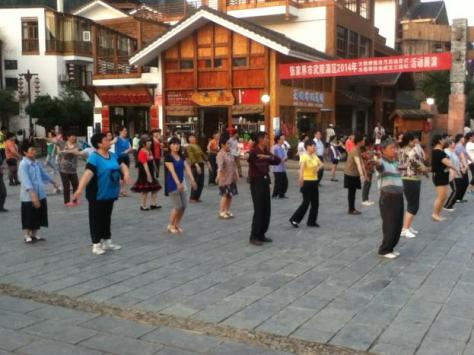
The town was charming. I particularly enjoyed the group folk dancing that occurred every evening near our hotel.
ZHANGJIAJIE NATIONAL PARK
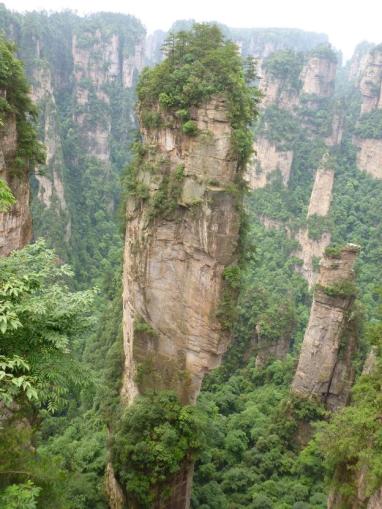
Zhangjiajie National Park was China’s first national park and is still most popular for both Chinese and international tourists. We saw many Chinese tour groups there. It is a UNESCO World Heritage Site and, as I mentioned, the site of much of the background scenery in the movie Avatar.
Admission is fairly pricey, about 250Y, but it includes three days of admission and bus transportation within the park.
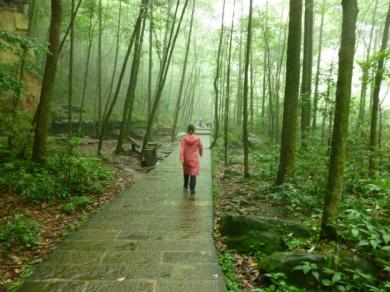
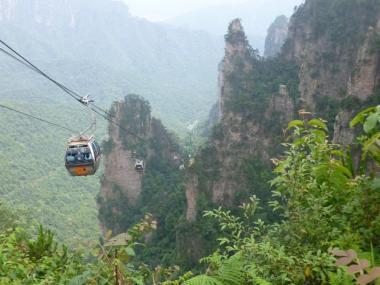
The first day we went for an 8km walk along a stream, enjoying the scenery and the monkeys who would come down and pose. The next day we ventured to the higher reaches of the park. This involved a ride on the world’s highest outdoor elevator and a tram ride, each of which had its own fee. Beautiful scenery at every turn.
China was first unified under the Qin dynasty in the third century BC and Xi’an became the first capital of a unified China. Its name means “western peace.” Xi’an is best known today as the home of the Terra-Cotta Warriors built by the first emperor, Qin Shi Huang.
Our 10:30 flight from Zhangjiajie on Capital Airlines arrived in Xi’an after midnight.
Our original plan had been to spend our time in Xi’an with our friends JM and EK and their friend Mr. Namhae (so called because he lives on the island of Namhae,) who has many contacts in Xi’an. Since March, however, their group had expanded to fifteen and become a formal tour. As a result, we saw them only for two dinners and a massage.
JM called the morning we arrived and offered us their seats on the tour to the Terra-Cotta Warriors, but that would have meant getting up and out early, so we passed. Unfortunately, we missed her later call inviting us to lunch with the local Communist Party leaders to discuss a showing of EK’s art in Xi’an. This will occur next year.
We spent the first day trying to get cash and exploring the city on foot and by bus.
After finally obtaining some cash we booked a tour of the Terra-Cotta Warriors at a nearby youth hostel, which offered a much cheaper tour than our hotel(Citadines Central Xi’an, $65/night).
On Saturday, the 21st, we spent the morning riding bikes on the city wall, about 8 miles around. As we rented the bikes, the clerk asked for my passport. She then calculated my age and started to tell me something that I didn’t understand. At one point I had the impression that I was too old to rent a bike, but I did eventually get a bike. We finally concluded that what she was saying was that I was too old to be covered by the insurance included in the fee. This did not lead to a lower fee, however.
This incident became even more interesting an hour or so later while we were stopped on the wall looking over one of the gate courtyards. A gentleman approached me and asked very politely, in English, if he could ask me a question. I said yes and he asked how old I was. I told him and he said, “How come they let you ride a bike, but they won’t let me?” I had no answer.
On our last night in Xi’an we had dinner with the tour group at a mushroom restaurant. Dinner consisted of 15 different kinds of mushrooms. One of the Korean travelers had brought a bottle of Johnnie Walker Gold which paired with the mushrooms quite well.
China, despite having no team in the tournament, was World Cup crazy:
TERRA-COTTA WARRIORS
In the third century BC, the first Qin emperor, Qin Shi Huang, began the construction of his tomb and of a fully equipped army to defend it. The location of the tomb was documented and known for centuries, but the existence of the warriors was lost to history.
In 1972, a farmer, Yang Zhifu uncovered pottery in the shape of human body parts while digging a well. The archeologists quickly moved in and an army was discovered – infantry, archers, middle level officers, generals, horses, wagons, etc. The tourist site today consists of three pavilions where excavation and reconstruction are still going on. It is expected that other sites, nearer the tomb, are yet to be found.
Our tour included breakfast at the hostel, which turned out to be a made to order full American breakfast, a nice surprise. The group numbered about 15 and consisted mostly of young folk, some traveling and some working in China. One young lady who was teaching English in a town outside of Chengdu told us she could make three times the money in China than she could in her native South Africa.
During the bus ride, our tour guide went up to people one at time and asked them about their ids. She never came to me, however. I found out later that she was giving people fake ids, the South African lady told me she was given an expired student id. We were then all steered to one particular ticket taker. Clearly, the tour company was saving on admission prices.
YK had not been able to get a mileage flight back to LA from Xi’an, so our return trip was from Chengdu. We had an early afternoon flight on Hainan Airlines from Xi’an to Chengdu on Sunday, June 22. In our wanderings in Xi’an we had noticed an airport bus leaving from near our hotel and, since our cab ride from the airport had been pricey, we decided to take the bus. As soon as I got on line to purchase tickets, a young woman approached me and asked when our flight was. She told me that the next bus was not until 11 and the ride was two hours. At first I assumed she was with the bus company, but she turned out to be one of those street entrepreneurs one finds in China. She said she could get us a ride to the airport for 100Y. Since the bus tickets were going to be upwards of 50Y, I said ok. She then introduced us to her “brother” and we all walked a block or two to his cab. After we had settled in, she reappeared with another couple and we were off to the airport. Worked out well for everyone.
Chengdu, with a metropolitan population of about 15 million, was recently voted (by someone) China’s most livable city. It’s easy to see why. It is cleaner and more modern than other cities we’ve visited in China.
Our flight from Chengdu to San Francisco was on the much delayed Boeing 787 Dreamliner, a nice plane. Its most notable feature is the larger window size with no window shade. Window tint is controlled electronically.
— YK added the following:
We had one afternoon + evening in Chengdu. We took a cab to our hotel, Chengdu Grand Club Hotel($62), about a15-20 minute walk north of the city center. We did not have enough time to visit the panda research center, but we could get to know the city a little.
Wenshu Yuan Monastery was not far from the hotel, but we were templed-out by then. So we took a cab to Jinli Pedestrian Street to have some snacks. We always have time and energy for that! We could have gone to Kuanzhai Ancient Street of Qing Dynasty, but we were getting tired of walking. So we went to eat dinner. Well, snacks are not meals, mind you! Chengdu offered lots of choices including pizza, burgers, Mexican, Italian, Irish – you name it.
Pat, an Irish-American, loves spicy food. I, a Korean-American do not. This meant no Szechuan dinner. I had been really burned at the last Szechuan place in Beijing we were invited to, and I was quite weary, no, afraid! We found a great restaurant without bloody red colored plates of food in their menu book. Can’t remember the name, but, there are lots of non-Szechuan Chinese restaurants in the city.
After dinner, we thought of going to the Szechuan Opera, but instead, we walked around the People’s Square a little to digest & went to bed.
[March 2018 Update]
We had a 24 hour layover in Chengdu on our way to Bangkok in March 2018. This time we stayed at a hotel right on the central square(Tianfu Square) so we could walk to a lot of places. We arrived late at night and went to bed. The next morning we strolled over to the People’s Park, their Central Park.
Spring was showing its force in March. There were lots of people already in the park
Tai-chi type exercisers were almost expected.
But we were surprised to find ballroom dancers. We’d met many excellent Chinese dancers on various cruises we’d been on, and we’d seen dancers in the parks of Shanghai, Guilin, and other cities. However, Chengdu dancers were there at 9 AM!
People were just slowly strolling in the park, and the vendors were out in force as well.
We ordered a set menu, and dumplings were delicious. Not expensive.
Then we walked over to a tea house next door which had a lakeview.
Aside from tea and snacks, you can order a special service: ear cleaning. Kill two birds with one stone — no, we didn’t try.
Not far from the park, there’s Sichuan Art Museum/Gallery in this distinctive building. Not a whole lot to see inside, though. Well, it’s free.
This was Pat’s favorite among the artworks displayed at the time.
Then we took a cab to an old poet’s house museum, Dufu Caotang. Dufu is considered to be one of the greatest poets in Chinese history, and he had build a thatched roof house at this location and lived there from 759 to 763. Now it’s a museum honoring the poet, and its garden is beautiful & nice to walk around.
We meant to visit Kuanzhai Alley last time we were in Chengdu, but we didn’t. So that’s where we went next. The best people watching spot in Chengdu, maybe. Then, again, there were just too many people.
You can see many beautiful old houses that are restored to retain the exquisite details in this area.
cool dudes
There were many artsy galleries and shops among the endless array of cafes, restaurants, and stores of all kinds.
We had dinner near the hotel before heading to the airport to catch a late night flight to LAX. We had considered visiting the Panda park, but Pat said he had seen enough pandas already. So we had stayed in the city, and that worked out find.