
Norway in a Nutshell: Oslo to Bergen + More

May 2015

We flew into the  Oslo Airport from Berlin, took the airport train to the central station, and walked to our Airbnb apartment not too far from the station. It rained the whole two days we were in Oslo, and we did not get to take too many pictures. We did manage to stand in line, in the rain,  for the Munch Museum. Museum staff did something memorable: they came out with umbrellas for those of us standing in the rain!

We used the public transportation to get around and that worked quite well. We took the ferry from the dock in front of city hall to reach to the Fram Museum and the Kon-Tiki Museum on the Bygdoy peninsula. From there, we took the bus to Vigeland Sculpture Park to see the famous sculptures of  Gustav Vigeland.

The next day we took the 6.5-hour train trip(about $100) to Bergen. Even in May, we could see snow on the ground in the mountain areas we were passing through. No wonder Norway wins all those medals in the Winter Olympics!

Bergen is located on the west coast of Norway and is its second largest city (population:270,000.) Most tourists go there to visit nearby fjords, but the city itself has enough to offer to warrant a full day or two of a nice visit.

It turned out we had arrived on National Day and the town center and port area were thronged with people in traditional garb.  There were many nice looking restaurants, all crowded and expensive.  We finally found a restaurant that would take us, a second-floor Chinese restaurant.  As we opened the menus we saw an insert that read, “In honor of National Day all prices are increased 10%.”

Since we cannot locate our pictures, I found some pictures from the internet that resemble what we saw.

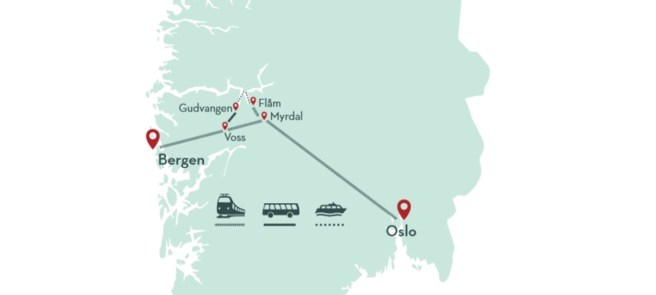
The next day we took our “Norway in a Nutshell.” This is one tour that is supposed to showcase the natural beauty of Norway.  It was an all-day affair involving a boat, a bus, and trains.
norwayNutshell

Some people include Oslo and Bergen in the package, but you can customize the tour any way you want on their official website. Some tour companies sell this product as part of a longer itinerary, but it is cheaper to do-it-yourself on this website. Our all-day tour was about $200 per person.

This is the description of our tour:

Starting from Bergen you first set out on a scenic train journey to Voss on the Bergen Railway. From Voss you travel by bus through charming villages and scenic nature landscapes, towards Gudvangen. From May-September the bus travels down the steep hairpin bends of Stalheimskleiva.

The bus will arrive in Gudvangen, where you continue the tour by taking a fjord cruise on the on the narrow Nærøyfjord and the magnificent Aurlandsfjord. The Aurlandsfjord is a picturesque fjord that offers stunning views, while the Nærøyfjord is a dramatic fjord surrounded by high mountains. Nærøyfjorden is one of the most narrow fjords in Europe and included on UNESCO’s World Heritage List.

After your fjord cruise you arrive in the small village of Flåm, nestled in the innermost part of the Aurlandsfjord, where your tour continues by taking the legendary Flåm Railway. The Flåm Railway offers spectacular panoramic views to some of the wildest and most magnificent nature in the Norwegian fjord landscape.

The Flåm Railway will arrive in Myrdal, where you change trains to the Bergen Railway. You travel back to Bergen on round trips, or continue through scenic mountain terrain to Oslo on one-way trips.

In Flam, there was enough free time for lunch and some shopping. We were a bit concerned about the tight timing for the train transfer in Myrdal, but it was a pretty smooth transition. It did not look like anyone would be left behind because of a confusion in finding the right train.

The next morning we flew out of Bergen to get back to the U.S.
Hangzhou(China)

February 2017

P1030162

There’s a Chinese saying that the most beautiful women come from the West Lake(Xihu) of Hangzhou. Marco Polo was supposed to have called Hangzhou, “the city of heaven.” Then there is another Chinese saying, “Be born in Suzhou, live in Hangzhou, eat in Guangzhou, die in Liuzhou,” meaning Suzhou was renowned for its civilized citizens, Hangzhou for its scenery, Guangzhou for its food, and Liuzhou for its wooden coffins which supposedly halted the decay of the body.

Those would be too much of a hype to follow through for any one place. We never really were struck by the beauty of the ladies we ran into on streets of Hangzhou. Nor did we feel that we were in heaven or find the city exceptionally beautiful. But we liked it.

We liked Hangzhou because people seemed to stroll, not run. The air quality seemed ok. We were there only for one day and a night, but we could picture ourselves spending more time there without doing much. For a city of 8.7 million people, it managed to stay low-key.


Yes, the Lake! We wanted to see the free light show in the evening, but there were just too many people where it was happening on the eastern shore of the lake. After waiting in the antsy pushy crowd for close to a half an hour, we gave up. We just walked very slowly east toward the Qiantang River(map link) for a mile or two, and that was fine. There were lots of shops and eateries along the way, and we had our dinner at a place packed with locals talking and laughing.

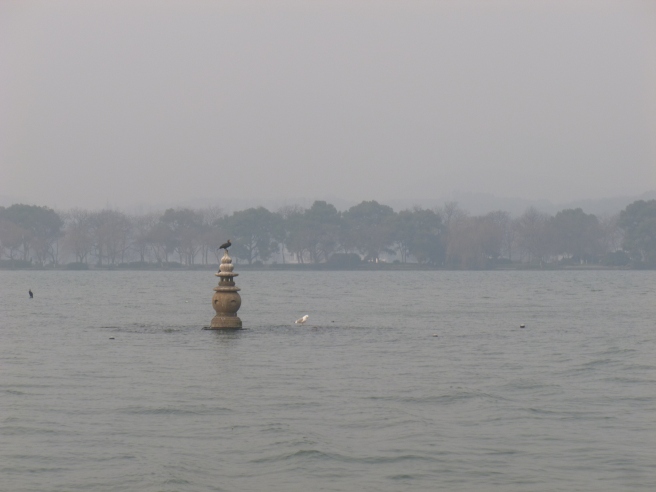
Hangzhou was a stop on our 8-day tour package we found on Travelzoo for $549pp. The next morning we were driven to a park on the north coast of the West Lake. It was in February, but some flowers were blooming. From there we got on a boat to explore the lake for an hour or so. It was raining lightly off and on, but the calm lake seemed to show the romantic appeal under the mist. No wonder so many poets wrote about this lake!

Hangzhou can be a quick 50-minute train ride(78 Yuan) from Shanghai(180 Km) if you use the bullet train, but, our guide boasted that the travel time will be cut in half when the new plan is realized. I am not clear on the dates for this, though.

If we go there again, we will plan to spend at least two nights. We’d stay someplace between the eastern shore of the Lake and the main train station to be able to walk everywhere. We may want to try bicycling around the Lake(around 12Km).

Wiki Travel Guide to Hangzhou

[update: October 2019]

We DID go back to Hangzhou in about two and a half years, and, again, it was an overnight stop during a packaged tour. This time we stayed way outside of the city, and we did not get to walk around the old town. It was raining on and off, thus, it did not matter much.

As we entered the city, we stopped at Liuhe Pagoda on the eastern bank of Qiantang River. We did not have enough energy to walk up to the top, but we walked around the park complex.

The view we saw was pretty much the grey suburban high-rise development area.

We had dinner at this sea food restaurant behind our hotel. You choose what you want to eat from this area.

We picked some seafood and various vegetables, and they were steamed on your table. This high pressure cooking method retained the natural flavor and the freshness of the ingredients. Quite delicious!

The next morning, we had another West Lake boat experience.

From one angle, you could get this kind of view.

From another, you would get the view of a modern city.

Every Hangzhou tour includes a visit to a tea plantation. This area produces Longjing(Dragon Well) tea, and there are some well practiced sales people who are quite good at making you buy this expensive pleasure at what they call tea culture centers.


Suzhou(China)

February 2017


Our short tour of Suzhou started at the not-very-humble garden of the Humble Administrator’s Garden (Zhuo Zheng Yuan). Known for exceptional classical gardens, silk, and embroidery, one can’t claim to have been to Suzhou without visiting some of these gardens. We got to see the largest & one of the most beautiful one, we were assured. 

The bonsai tree collection at one end of the garden was quite impressive. If these were in any other city, there would’ve been a stand-alone attraction housing the collection.

Since this trip was a stop during a packaged tour, we did not have much control over what to see and how long we could stay. Some people took a boat tour around the canals, but we just walked through the alleys along the canals. Then we visited a silk factory, which was interesting enough even though there were heavy sales talks peppered in the program.

If we are to come back, we’d spend at least one or two nights and visit at least another garden just to compare and have some idea on the spectrum of the classical Chinese gardens.

for more information:  WikiTravel Link

[update: October 2019]

We did return to Suzhou in two and a half years again as a part of a packaged tour. This time they drove us in from Shanghai, spent the night, and had a tour the next morning.

The sun rising over the modern development. After all, more than 10 million people live in this city, and the old houses can’t handle that kind of crowd.

Embroidery is another specialty of Suzhou. They claim this place as a museum, but it is more of a showroom than an embroidery art museum. Still, the pieces on display were impressive. The one above is one example. The black cat and the yellow cat are on the same panel: you flip the panel to see the other side.

Klimt? Van Gogh? You name it, and they can recreate it one stitch at a time. It may take over a year, but the skilled artisans of Suzhou can do it.

We did get to visit another garden: the Master of Nets Garden. Much smaller than the Humble garden we saw last time, but it was equally beautiful.

Once again, some people got on the canal boats, and we just walked around the area.

There were lots of local people strolling in the area. Some fruit shops had exceptionally beautiful displays, but, they did not allow us to take pictures. (Luckily, the internet can show you some examples.)

There were some fancy houses along the canals. We had fun being part of “Old Suzhou” for a couple of hours.