I had arranged to pick up a rental car from the airport because the rate was cheaper there than in downtown, and we would have to go to the airport the next morning to return home. The quote we had received from Advantage arranged through Travelocity.com was $55. When we got to the airport, we found out Advantage dumped our reservation on Eurocar, and they wanted $160.00 for the one day rental! Long story short, Travelocity picked up the difference, and we were off in the most expensive standard car we ever rented.
It was a pleasant 90 minute drive: a half of it in the field with trees with nobody in sight, and, the other half along the coast.
The first thing we noticed as we got closer to Punta del Este was 3-4 cruise ships moored in the bay. It is a popular stop in the Brazil to Chile cruise route, I learned. This town of 8,000 people add 300,000 more people during their summer months.
Punta del Este is supposedly the Monaco, Hamptons, or Miami of South America. Having lived in Honolulu and currently living in Los Angeles near the beach, I am not easily impressed by modern beach resort towns. Punta del Este seemed like a nice clean town with 20 miles of sandy beach. But I did not feel we were in a paradise or in a special place.
I thought we’d have a nice sea food lunch, look around, and go to Casapueblo, my real destination of the day. A restaurant named Rustic was my choice, but Google kept saying we’d arrived at the spot where there was no restaurant of any kind. It was a really hot day, and we were getting tired. So we just walked into a fancy diner type place. They had a nice bakery, and the food was not bad. Ouch! Very expensive. This is not a cheap town.
I lifted this photo from Wikipedia to show a better perspective of Punta del Este. We did not feel like walking around under the scorching sun, thus, we left this town.
From there we could see Casapueblo, a whimsical dwelling built by an artistCarlos Páez Vilaró in 36 years. He started with a wooden beach house, then, added more rooms and floors each year. Now there’s a museum and a hotel in the 13 story complex.
There were a lot of people surrounding the building trying to take photos. Then there were tour buses, too. Instead of fighting the crowd, we bought the restaurant package that was offered at the front gate of the hotel and slipped in. We took the stairs down to get to the lobby and then took the elevator down to the restaurant. Casapueblo is often compared to Gaudi’s buildings in Barcelona, but, unlike Gaudi, Carlos Paez-Vilaro was not an architect. I could just picture an artist going wild with his imagination with an enormous toy house.
The restaurant package worked like this: you pay about $15-20 upfront at the gate, and when you get to the restaurant, you get that much food credit. We sat at one of the tables on the balcony, and the view was just gorgeous all around. I could tell Paez-Vilaro hand picked this spot himself. This is what he said about the house:
“I built it [Casapueblo] as if it were a habitable sculpture, without plans, especially at the request of my enthusiasm. When the municipality recently asked me for the plans that I did not have, an architect friend had to spend a month studying how to decipher it.
It is mind boggling to think he added a bit by bit each day and one day it’s become a 13 story building unlike anything else! Of course each unit or room in the complex is different from any other. I’d love to spend a couple of nights there and see some of the rooms. Sunrise and sunset would be just magical, too. (The museum holds a sunset ceremony everyday.)
Our bus from Colonia del Sacramento made many quick stops, like 30 seconds each, along the way during the two hour drive to Montevideo, the capital of 1.4 million people. The scenery was not particularly exceptional, but it was not bad, either, as shown in the picture below. It rained on and off the whole day.
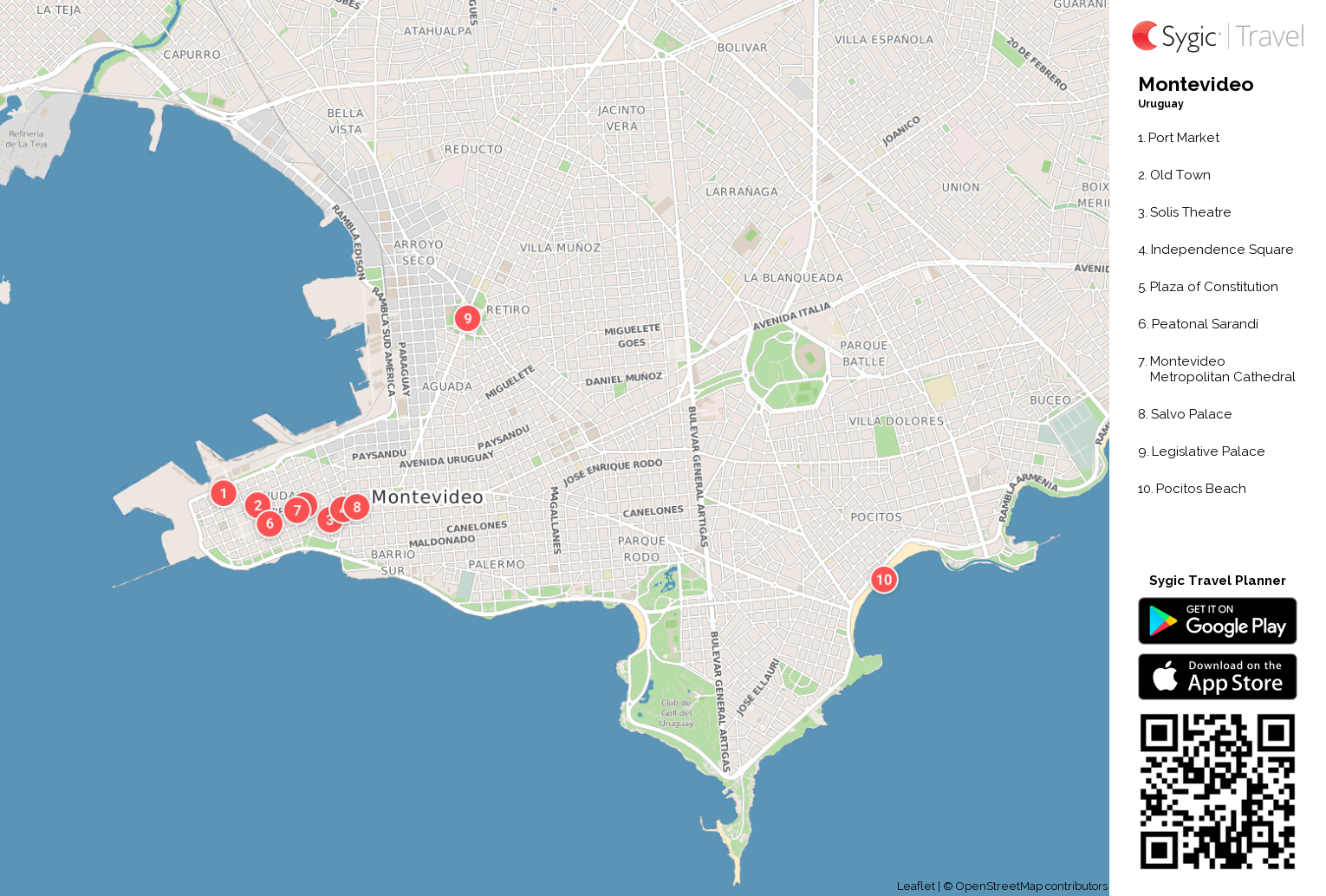
Map 1: Montevideo
I had been curious about Montevideo because it attracted many retired Americans. What would draw people to this far away city to spend the rest of their lives?
As shown on this map, most tourists visit the old town area to the left on the map and the beaches along the coast. We stayed at an Airbnb apartment in the area a bit south of the red dot marked number 10. The apartment was very comfortable and nicely decorated. From our place to the Old Town was about 15-20 minute drive.
We were hungry when we arrived, thus, we first went to an Italian restaurant recommended by our host a few blocks north of our apartment. The food was quite good, but, what shocked us was the price. It was almost like in the U.S., and we had been conditioned to expect much less by traveling in Chile and Argentina. What we didn’t realize was that visitors automatically got the 22% VAT tax refunded by paying with a foreign credit/debit card. This program was started in order to attract tourists from neighboring Argentina, I heard. We probably got the same discount in Colonia, but we didn’t look at the receipts carefully.
We just relaxed the rest of the day and walked around the neighborhood when the rain stopped. The beach was a half a block away, and it looked like a nice beach when the sun was shining. There were several markets and enough of a variety of restaurants to choose from in the area.
We ended up going to a modern Mediterranean restaurant called Bruta for dinner. Excellent food and cocktails. Not too expensive for the quality you get. Our server was very friendly and spoke English.
We started the next day at the Sunday street market Feria de Tristan Narvaja. We called an Uber, and he got us as close to the street as possible. People. The street was jam packed.
Items they sold were quite a mixture.
Mate drinking figured huge: everyone carrying the mate cup, every other vendor was selling something to do with the custom of mate drinking etc.
We were to join a free walking tour at 2 PM, thus, we had to have lunch before that. The meeting point was at the Plaza Independencia, and we looked for a lunch spot around there.
Surprise! A Korean restaurant! We had to try. The food was actually better than expected. Our waitress was definitely not Korean, but she pronounced names of the food in perfect Korean.
Plaza Independencia is the central plaza that separates the Old Town (Ciudad Vieja) and the rest of downtown. In this photo, the father of independence, Jose Artigas statue (his mausoleum is underneath) is on the left, iconic Palacio Salvo building in the middle, and the presidential office building on the right.
The walking tour started from here and passed through the original city gate and veered left to reach Theatro Solis, the most important performing arts center in Uruguay. (I looked at their website to catch a concert or something, but the timing didn’t work for us.)
Libreria Puro Verso, a famous book store in a beautiful building. We did not have time to go inside, though. We walked toward it to get on Sarandi Street (Peatonal Sarandi), the pedestrian only street that connects the Independent Plaza and the coastal walkway, Rambla.
Plaza Matriz (Constitution Square) is the oldest plaza in Montevideo where the first constitution took effect almost 200 years ago. The Cathedral is on this square as well as an old government building Cabildo that is used as a historical museum now. This is where we all sat around and took a break and chatted. Most people were from surrounding countries, and they all said it’s at least 50% more expensive here than in their own countries. Why? It’s a small country with only 3.5 million people, and it’s harder to keep the cost down in a smaller economy – I think that’s what the guide said even though it was not easy to hear everything he said in a public park setting. Also it is the least religious country in South America with only 40% Catholic, which resulted in it being more liberal & democratic and enjoying more freedom of the press. Uruguay is the richest country in Latin America.
There was an artisan market going on in this plaza, and we thought we would come back to check it out later. (Well, one of us did & found some unique gift items.)
There were numerous cafes with interesting decorations and murals in the area. We considered checking out teatime (called merienda in Spanish) at the oldest coffee shop in town, Café Brasilero, but it was too early for that.
Over all, the old town area didn’t look too old – the city was founded in 1726, and that is relatively new compared to many European cities. But it was an interesting area to walk around. The streets were not terribly crowded since we were there on a Sunday, and many shops were closed. Most tourists were from the cruise ships docked at the port right in the old town.
The tour ended at the old port market, Mercado del Puerto, in operation since 1826. Nowadays it’s more of a touristy food court than a local market. We found the restaurants there more expensive, but we had to try some local grilled sausages. So we stopped at a place for a quick snack shown in the photo below.
Later in the evening, we took a walk along the coastal road by the beach. Sunset was beautiful. I thought about going to a cafe and concert-style space called La Trastienda, but we were tired. Maybe tomorrow night.
The second full day in the city started out as planned in Barrio Reus, also known as the neighborhood of Jews. The buildings here are painted in bright colors and attractive murals. This area is about 9-10 blocks NE of the red dot marked as #9 on Map 1 above.
We walked 5-6 blocks SW to get to Mercado Agricola, an old agriculture market converted to a modernized market and food court.
you can’t miss this attractive structure
I ended up having a pasta dish while Pat had a hamburger and some beer. Good food. Not necessarily cheap.
Walking south toward the #9 spot, we noticed this unusual building. Not sure what it is.
#9 turned out to be the National Congress building. Again, tour groups from cruises were there to take pictures.
I asked a passerby, “who is he?” “He’s a famous writer,” he said. Someone else thought it’s the popular ex-president, Jose Mujica. Maybe I misunderstood their English.
Don’t ask me what it says. We had to wait a while to find a taxi, but we eventually were able to go to the old town area.
Now it’s Monday, and the streets were much more crowded.
this photo is from Wikipedia
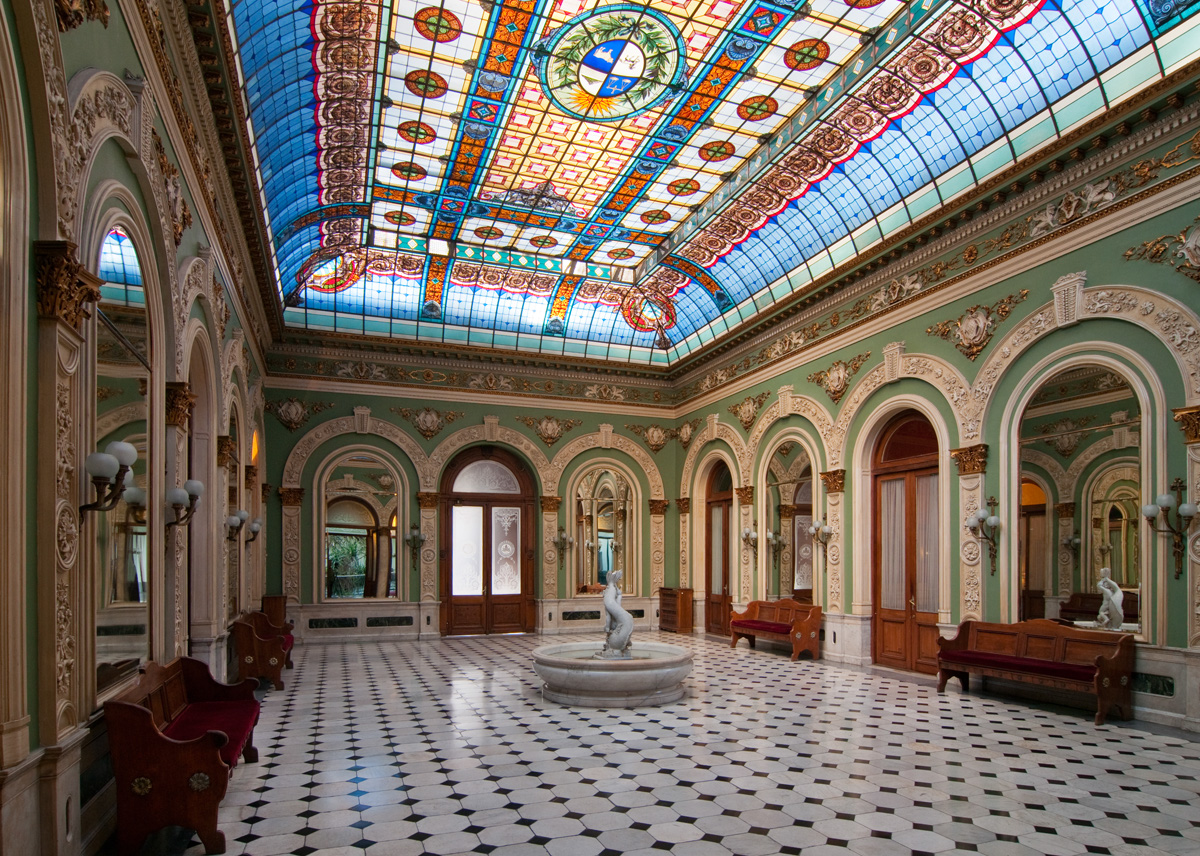
I had a mission this day: to figure out where this place is & go there. I found a photo similar to this one in a magazine article that was not about this place, and I was drawn to it. All I knew was it was in Montevideo. I had shown the photo to several different people, but nobody knew.
I walked into this museum, a decorative art museum, in Old Town thinking a curator may recognize the photo. Sure enough, two nice museum employees put their two brains together & found it: Palacio Santos! They looked up the address online & carefully wrote it down on a piece paper for me. Muchas gracias! (If you click this link, you’d understand how illusive this place was!)
Well, we walked to the address, and there was no such street number on the 18th of July Street, their main street in downtown. I searched Google, and, sure enough! The address the ladies gave me was the one that Google had. Don’t get me wrong. I love using Google, and thank them a lot. But, when it is wrong, it is wrong.
I finally found someone who knew where Palacio Santos was: 3 blocks up the road in a Ministry of Foreign Relations complex. Yes, he was right! But it was closed for the day.
We came back exhausted. Let’s eat in and stay in tonight. We all agreed. Nice sunset, though.
On our last day in Montevideo, we rented a car and drove out to Punta del Este. This would be a separate blog.
The last night in Montevideo was supposed to be our big night out. I picked a wonderful BBQ restaurant everybody told us to go, La Otra, as our dinner spot, then, maybe, some music… It was Christmas eve, and nothing was open. We walked around a while to find any place we could eat at and failed. We came home and raided the almost-empty fridge: old pizza slices, some veggies, eggs. Merry Christmas! There were serious fireworks going off all night to make sure we could stay awake and celebrate.
sunrise at the airport parking lot
If we had another day, we would have gone to Bodega Bouza winery 20 minute drive north of town to taste Uruguayan wine and have lunch there. On the way back, we would have stopped at the botanical garden and an art museum nearby, Blanes Museum, to check out art works by local artists. I would also try to find a way to experience candombe, the unique Uruguayan music and dance involving a big group of drummers.
Montevideo Airport is not like a big, imposing airport in bigger countries.
So would I be willing to retire in Montevideo? It’s a nice place with no visible slums, good living condition, friendly people, easy to get around, cheaper living cost than in the U.S., nice beach & interesting enough Old Town. If one has no strong desire to visit the U.S. too often, maybe this is not a bad place. It could even be a perfect place if one doesn’t want too many visitors from back home. But, personally, I’d choose Hawaii or Mexico or many other places before considering this place. Oh, well.
The ferry from Buenos Aires to Colonia del Sacramento(population: 27,000) took about 70 minutes to cross Rio de La Plat. We chose Colonia Express ($36) because their schedule fit ours best even though the other company, Buquesbus, supposedly had better boats and service. The exit immigration was efficiently done at the ferry terminal. The boat was full of young people going to Montevideo for the weekend, and they all preferred to stay on the tiny outside deck, thus, there were many empty seats inside till the rain started pouring down.
The water got really choppy as we approached Colonia (everybody used this short form of the name) port, and our captain had a hard time pulling into the dock. This killed 20-30 minutes. Once we got off the boat, most people went directly to the buses waiting outside the terminal to go to Montevideo. (Colonia Express sold ferry+bus combo tickets.) The arrival immigration was fairly quick. We chose to stay in Colonia overnight to see what this town, a UNESCO World Heritage site, was like.
Our Airbnb house was in the area left of the Bus Terminal (bottom right on the map.) Avenue General Flores is their Broadway. The historic quarter, toward the western tip of this map, is only about 6 blocks long and 5 blocks deep.
Under pouring rain, we braved the weather and walked 9-10 blocks to find this restaurant. Food was decent, but the prices were definitely higher here than in Chile or Argentina.
Avenue General Flores in the old historic section – the busiest street in town with restaurants and shops. Maybe because of the rain, the town was empty of tourists. Locals were in grocery stores and restaurants.
Of course! The hero of Latin America had to be here, too. Colonia was literally a colonial town that changed hands 11 times till it became part of Uruguay in 1828.
According to Wikipedia, this is the Timeline of rule:
We walked on Av. General Flores all the way to the end, and the sky was displaying an abstract painting over Rio de La Plat. By doing this, though, we missed the city gate of the old Colonia. We turned left and followed the coastline. The rain did not let up, and the wind was showing its force.
We came to the old lighthouse and turned onto a street that led to the Plaza Mayor. Good time to go inside, we decided. Conveniently, there were several museums in this area. You buy one ticket, and 8 museums were covered. We were happy to duck into a building, then, when we came out, jumped into another one we saw.
Yes, almost every colonial town has a painting like this. Guns come in and take over the town.
This place claimed to be the oldest cafe in town. The rain got a bit lighter, so, we walked a couple more blocks to find the Cathedral.
There was an elaborate display of the birth of Jesus in one corner of the church. It was Christmas time when we went there.
There were some artsy shops and cafes in the area. It was time for a break for us.
Even though we could not pronounce the name, we loved this cute cafe. Their tea service was great & went really well with the carrot cake.
Gardel, the king of Tango, was present. After all, Colonia is just across from Buenos Aires, the Tango Capital!
Rain or shine, the weather could not make up its mind and showed both.
Pizza and Chivito for dinner. The restaurant recommended by our host was not open. Because of the rain? We would never know. So we walked into a restaurant where a friendly owner was outside chatting up the passersby. I had to try their national dish, Chivito – a huge hamburger with a fried egg on top. Not bad. Too much food for me, though.
Next morning, we walked to the bus terminal & got on the bus to Montevideo.







 The water got really choppy as we approached Colonia (everybody used this short form of the name) port, and our captain had a hard time pulling into the dock. This killed 20-30 minutes. Once we got off the boat, most people went directly to the buses waiting outside the terminal to go to Montevideo. (Colonia Express sold ferry+bus combo tickets.) The arrival immigration was fairly quick. We chose to stay in Colonia overnight to see what this town, a


.svg)


.svg)
.svg)


.svg)


 Small Wide World