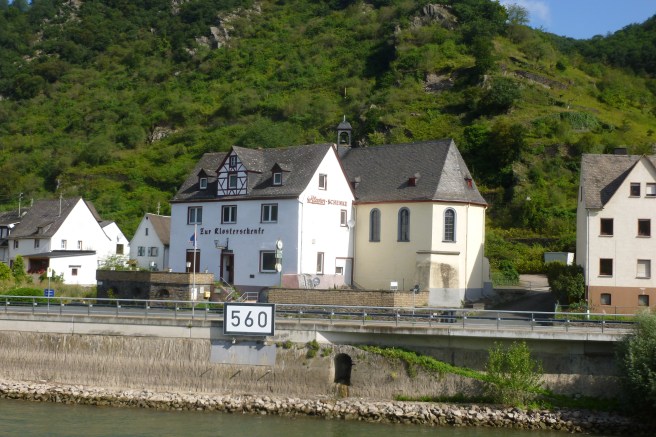
Our cruise director pointed out that a church and a bar share the same building in this picture, and they happily coexist. After all, people do not have to walk far to get a pre or post church drinks to contemplate the sermons!
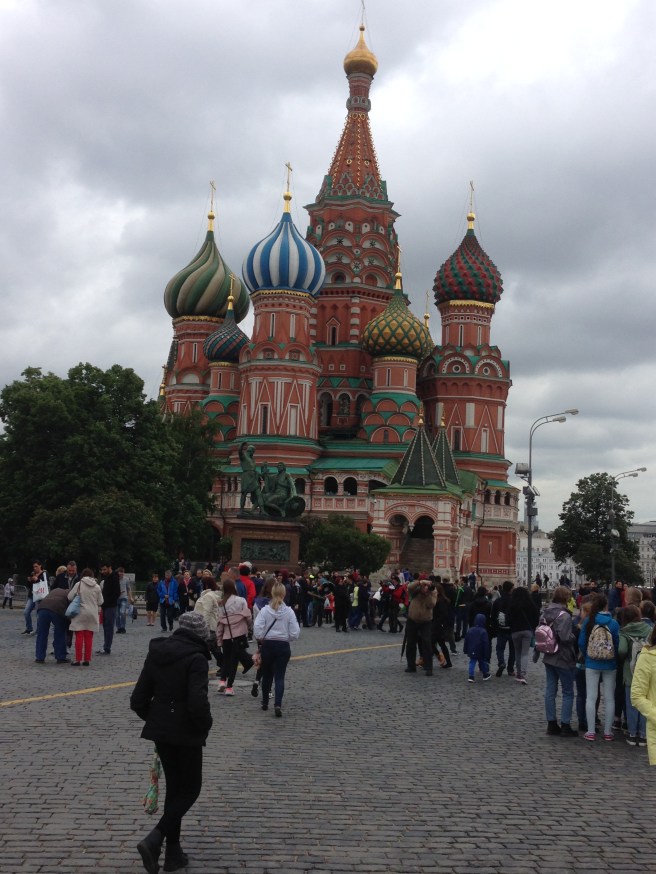
No, that’s not snow. This was about the only red building in Red Square.
About 40 years ago, my mother said she wanted to visit Russia, but she did not want to go alone. Since my father was not interested, she asked me to become a U.S. citizen so that I could accompany her. South Korea was one of the staunchest anti-communist countries in the world at that time, thus, there was no way I could make the trip as a Korean passport holder. I did listen to her, but my application was not processed fast enough to get me naturalized before my move to New York City for graduate school.
I imagine my mom is having a grand ole time visiting any country she wants any time she wants now that she is on the other side of the pearly gate. I still hold a Korean passport, and I can go to 172 different countries around the globe not bothering to get a visa. On the other hand, Pat, a U.S. citizen, had to pay a visa fee of $380 to get to visit Russia. Why not go to Moscow, I said. Pat said, yeh, why not. We would be in Amsterdam after a Nordic cruise, and we were to go see friends in Siberia from there. Changing the plane in Moscow on the way sounded quite logical.
Belavia Airline is based in Minsk, Belarus. The cheap fare($150) got us from Amsterdam to Moscow in 6.5 hours with a flight change in Minsk. The atmosphere at Minsk airport made us think we were actually already in Russia– but about 30 years ago under the Iron Curtain. We did spot the cheapest duty-free bottle of vodka anywhere around the world. The arrival airport in Moscow, Zhukovsky International Airport (ZIA), which handles the flights mostly from Minsk and Central Asia, was not particularly welcoming, either. It was far away from the city center, and most people didn’t even hear of this airport.
When we finally arrived in the city of Moscow, we did not feel we were in any kind of Russia we had seen in films. It seemed closer to Disneyland than a country run by any sort of an oppressive regime. The only reason these pictures look grim is the rainy weather we ran into. People everywhere taking selfies, drinking, eating, laughing: it was just like any other big city that attracts lots of tourists.
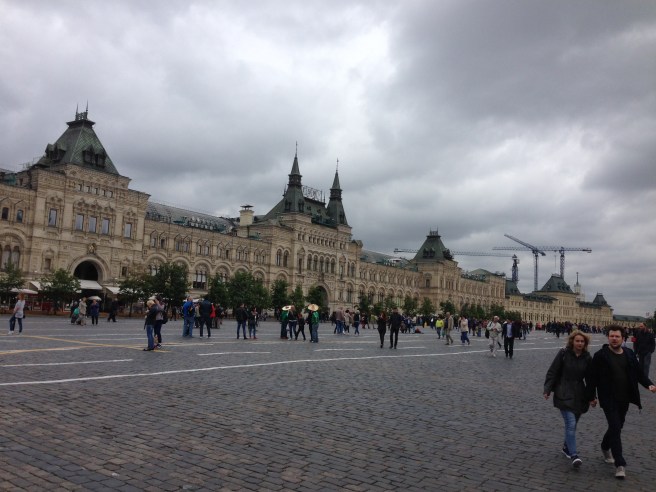
GUM
Kremlin. Red Square. Super secrecy. Was I brainwashed by all the spy movies?
In reality of 2017, the Kremlin was raking in bushels of money welcoming tourists into much of the government compound. Red Square boasts one of the fanciest shopping malls in the world, GUM, shown above. Nobody was rushing or running scared in the Red Square. There were no soldiers in sight except for a few policemen directing the traffic.
The Cathedral of Christ the Saviour (Russian Orthodox Church)
Our modern Airbnb studio($60) in an older building was near this Cathedral. The first morning in Moscow, we decided to start from the Kremlin and walked over there to get the tickets, but there were just too many people. We gave up and walked along the Moskva River. We tried to go into the Cathedral, but it was under renovation. In fact, the whole city seemed to be under renovation or construction as witnessed by the cranes featured in the photo of GUM.
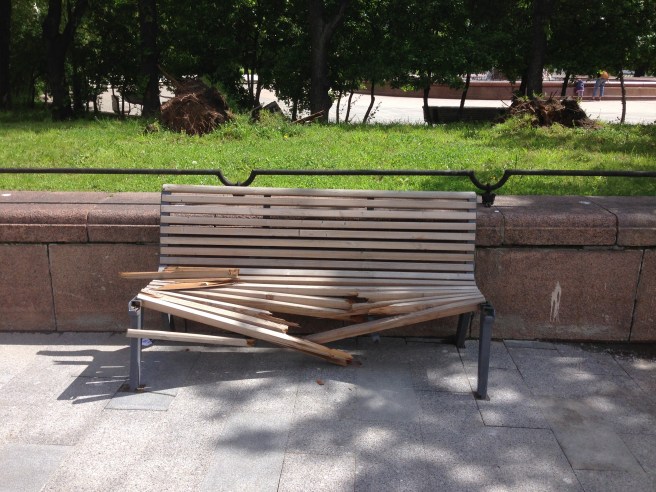
We slowly crossed the bridge that connects the Central Moscow to Central South Moscow. When this bench appeared on the way, we were not sure whether it was an art installation or a sign of drunken men getting in a fight.
We stopped in Tretyakov Gallery to see Russian art. I was looking for works of Marc Chagall, but those were part of the 20th Century collection which was in the Artist’s House Cultural Centre across from Gorky Park, we were told. Our tired feet told us, “Next time!”
The area east of the Gallary was filled with churches. We walked into a few of them, but we got really tired. Time for lunch. The previous night as we got off the Metro and trying to get to our apartment, we found a restaurant with a cow statue out front that looked to have free Wifi so that we could get in touch with our Airbnb host. It turned out to be a Russian buffet restaurant, and the meatballs we had there were excellent. There was a branch of it right in the area, and we went in. This time we were determined to take time and have a leisurely meal. The place was called My My in Russian, and it’s pronounced like Mu Mu.
After lunch, we walked back to the Central area by following the main road that gave us the view of the Kremlin from a different angle. It is an enormous compound, but it still looks more like Disneyland than anything else in my opinion.
After resting a bit back in the apartment, we ventured out to Arbat Street area for dinner. It is a pedestrian only area lined with shops and restaurants. For a touristy spot, the pricing was surprisingly fair to cheap for eating and shopping.
This slideshow requires JavaScript.
Our second day was the Metro adventure day. We hopped on Line 1 after a breakfast in our area, and we just got out at the well-known stations with beautiful or unusual interior design, looked around, got back on the next train, and continued.
A surprise happened on one Metro train while we were conducting our survey of the stations. Literally, an art museum came to the people! What a brilliant idea! An art display on a crowded train car gave people a pause, and people tried to move around to let others see the display.
We got out of the subway at Pushkin Square and walked toward Bolshoi Theatre admiring beautiful old buildings. Then we got back underground to continue our Metro Adventure.
We got off the train at Baumanskaya Station and came out to the corner of two main streets, then found a Shokoladnista Cafe on the second floor of the building standing right at the corner. We deserved this light lunch break!
Afterward, we casually walked down the main drag in this Basmanny District stopping to check out some churches and parks. It ended up being much longer a walk than we intended, and we were exhausted! Time for a nap back at the apartment.
The area we stayed in had some Soviet-era reminders: big, ugly, concrete buildings; murals from that time, statues and so on. But, then, there were other more refined structures that balanced the whole view.
We headed back to Red Square after dinner hoping to catch the storybook cathedral of St. Basil’s in all its night time glory. It never really got dark enough for us to see that, though.
After two full days in Moscow, we felt we had a pretty good feel for the city even though we did not cover all there was to see. It’s a huge city, but the city core is compact and easily walkable. If we ever go back, we will certainly stroll in the Gorki Park. And I’d want to visit some of the towns in the Golden Ring of Russia.
We did have time to visit Kolomenskoye, a former royal estate 7km south of the Center, before heading to the airport on the third day. It was served by the Metro, but the walk to the park from the station was not short. There were restaurants and food stalls near and inside the park. After we left the park, Pat said, “well, it was mildly interesting!”
Our flight out to Irkutsk was from Domodedovo Airport(DME), which was easily connected from the city. After the ZIA experience, this seemed too easy!
St. Petersburg, the bustling Cultural town of 5 million people sitting on the Neva River, was founded by and named after Peter the Great, a great reformer who led Russia to be the major European power.
Our tour of St. Petersburg started in Peterhof Palace, commonly known as the Russian Versailles. We were on Royal Caribbean Vision of the Seas cruise and stopped in St. Petersburg for 2 nights. We hired a local tour guide found online, Alisa, and she picked us up from the port. Alisa was very professional and punctual, and she really knew and understood the history and culture of her city. She quoted a very reasonable rate – about $105 per person for the all-day private tour for our group of 4 in a private van/driver. She provided the paperwork for one of the friends who did not have the Russian visa. (Cruise passengers were not required to have a visa, but they had to go with a licensed local tour company in order to be off the ship.)
We left the port around 8:30 in the morning and arrived at Peterhof a bit after 9:30 — early enough to beat the crowd. Alisa knew all the historically meaningful and photogenic spots. The most impressive and memorable were the fountains throughout the park, and each had a story to go with. We heard a lot about how Peter the Great admired Germany and other European countries and cultures, and he opened the eyes of Russian people who tended to be more tradition-bound.
She led us to a restaurant by the park entrance that was reasonably priced and helped us with sampling Russian dumplings and other dishes.
We drove back into the city center, parked the van, and walked a few blocks to see some monuments and famous buildings. She took us to this chocolate shop on their main drag, Nevsky Prospekt, that had a huge collection of handmade chocolates and candies. The shoes and the fruits below are all edible.
This slideshow requires JavaScript.
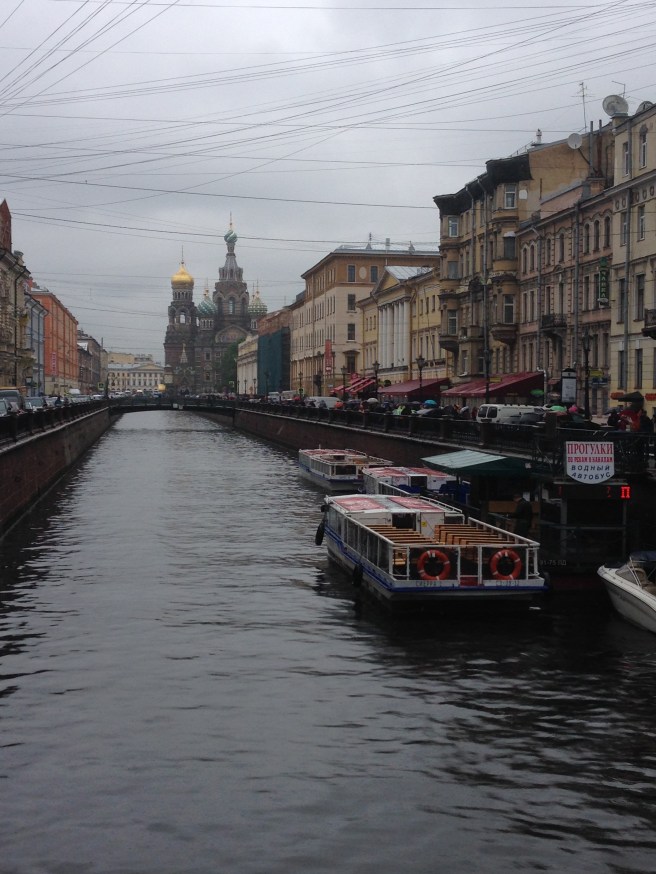
Next stop was the Savior on Spilled blood church above, and we went to St Isaac’s Cathedral below after that. By this time, every attraction in town was filled up with tourists. We felt lucky coming out still alive!
An excerpt from a description of Neva River, pictured below:
“The Neva is the main waterway of Petersburg and the town is situated along its banks and across the islands of its broad delta. It is one of the largest rivers in Europe by volume of water and also one of the world’s shortest major rivers at only 74 kilometers. The Neva connects Lake Ladoga, the largest lake in Europe, to the Baltic Sea. For centuries, it was of great strategic importance for transport and so the interests of the Russians, Swedes, Finns, and Balts clashed on its banks. From the 8th-13th centuries, the Neva was part of the trade route from Scandinavia to Byzantium, the road “from the Varangians to the Greeks.” In 1240, the Novgorod militia led by Prince Alexander Yaroslavich defeated the invading Swedish army on the banks of the Neva. Because of the victory, the prince was thereafter nicknamed Alexander Nevsky (of the Neva). But the main page in the history of this great river began to be written, of course, in 1703 when St. Petersburg was founded at the mouth of the Neva.”
We were on our own on the second day of our stay in St. Petersburg. This day we ventured out into town with two other friends who did not have a visa issue. We took the bus from the port to a metro station, then we started our tour of the metro stations. It is said that the Soviet government built these beautiful stations basically to show off. Well, that worked! It is very hard not to be impressed by each distinctive, beautiful or intriguing interior design applied to such mundanely routine place of utility.
Next, we went to the real holder of ascetic beauty, the Hermitage Museum. We wisely bought our tickets online way before our arrival in town, and we were ecstatic as we walked by the long ticket line and went to the ticket pick up office only foresighted people like us were allowed in.
When you walk into the Louvre in Paris or the Met in NYC, you know and feel that you are walking into a museum. At Hermitage, I felt I was visiting someone’s living room, well, a very big one, I might add. I could maintain this feeling till busloads of tourists arrived from the biggest nation in the world and filled every inch of the museum after an hour or so of leisurely viewing. Maybe it was worse because of the pouring rain, and the tour companies had to divert their guests into indoors. Maybe not.
Getting out was not a simple task while people were blocking all the stairs and doors. When we finally found all four of us outside the pale green buildings, we felt liberated. Rain or not. We were quite happy when we finally ducked into a restaurant on Nevski Prospekt, and we all had to order an alcoholic drink.
We will have to come back when there are not as many tourists. Maybe in winter?








 Small Wide World