Rudesheim(Germany)

August 2016

P1020771


Our river cruise stopped in Rudesheim, a small town(population: around 10,000 people) in the middle of the major wine producing region in the Rhine Valley that is part of UNESCO World Heritage area. A choo-choo train shuttle was provided from the boat dock to the town center.

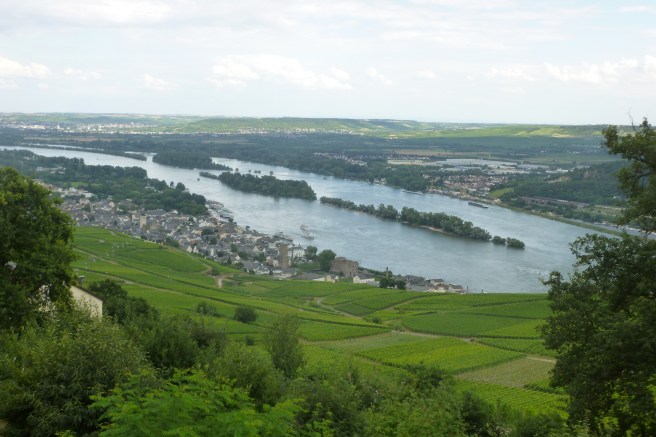
We got on the cable car(8 Euros, R/T) from there and went up to the park where the patriotic monument commemorating the unification of Germany, Niederwalddenkmal, stands. The view from there is what you see in the picture above. The town across the river is Bingen, known for the Catholic saint Hildegard of Bingen and the wineries.

The official name of the town is actually Rüdesheim am Rhein to distinguish it from the smaller nearby town of Rüdesheim an der Nahe. Other than the monument, pictured above on the left, this town has a famous shopping and dining alley called Drosselgasse. We stopped at a museum housing hundreds of music boxes in the town center before heading down this alley.

On Drossegasse, many restaurants served Rüdesheimer Kaffee, a coffee with Asbach Uralt brandy, served flambéed. We had it with a slice of apple strudel, and it was heavenly! By the time we got to the bottom of this street, we were close enough to the boat dock so that we could walk back to our ship.


Regensburg(Germany)

August 2016

Sausage. As one of the oldest(founded in AD 179) cities of Germany & situated right on the bank of the River Danube, Regensburg offers natural beauty, history, culture and more. However, the first word that pops into my head when I hear the name Regensburg is sausage.

The first time we were in Regensburg in 2014, we stopped there on our way to Munich from Switzerland.  We drove in and were able to park near the cathedral. We had read about this 900 year old sausage place right by the river, thus we basically walked down to the river and followed the smell. Wow! We never knew German sausage could be so delicious! Even though we did a quick spin around town afterwards, all that got stuck was the memory of these skinny sausage links!

The second time in Regensburg, we were on a river cruise & the boat stayed over night there. When we got off the boat, we went straight to the sausage kitchen. The whole town was much more crowded this time, and we realized how lucky we were to be able to find a parking two years prior.

The historic cety center, a UNESCO World Heratage Site, can be totally explored on foot. In fact, there are so many narrow alley ways that it will not be possible to use wheeled vehicles. Other than having the sausage, we had another mission to accomplish in Regensburg: doing our laundry. We try to carry as little as possible when we travel, and this requires occasioanl stops at a coin laundry. Thanksfully, a Google search of “Regensburg coin laundry” turned up a good one not too far from the boat dock.

While the wash machine was doind the work for us, we walked around the area and came across a Kolping House, a residence and cafe operated by the Catholic social development organization, Kolping Society. As a teenager in New York City, Pat had spent a lot of time at a Kolping House location near his high school hanging out with friends and drinking beer. Thus, it holds a special place in his heart, and he really wanted to try a mug of beer there. Too bad that it was under renovation & we could not get in.

With a population of around 140,000, Regensburg is a fair sized city. However, most places of interest are in the historic center. The cathedral was under renovation when we went there, but there are so many other churches in town that one can visit and admire. We spent the second day just wondering around town. It is that kind of city – discovering something accidentally while walking around mindlessly.

Kelheim(Germany)

August 2016

Kill what? Yes, that was about what our reaction was when we heard out river cruise boat was to stop at Kilheim. A town of 15,000 people, it was actually Kelheim, not Kimheim. It is situated on the river Danube at the confluence of the Danube and the Altmühl, i.e. the Rhine-Main-Danube Canal.

The most famous thing around here is the Befreiungshalle (“Hall of Liberation”),  a Neoclassical monument on the Michelsberg hill above the town of Kelheim. The view of the converging rivers from the ground of this monument was impressive even though I had a hard time placing myself on the map of the area due to winding rivers and so on.

King Ludwig I of Bavaria ordered the Befreiungshalle to be built to commemorate the victories against Napoleon during the Wars of Liberation that lasted from 1813 to 1815. Inside the monument was more impressive than outside, with marble tiles in interesting geographic patterns and 34 statues of victory looking down at you.

We were bused in and out to/from this monument from/to the ship.