Lima(Peru)

January 2016      Itinerary Link

Lima, a city of pisco sour, great food, and colorful textiles: this is how I remember the city. Our first time in this city was off of a cruise ship traveling from Florida to Valparaiso. The shuttle bus from the port of Callao, a not very attractive container port, deposited us in front of a shopping center in nearby San Miguel. From there, we took a cab to Kennedy Park in Miraflores section of Lima, a city that seemed to sprawl quite a bit. Over 10 million people live in the capital region of Peru, and we could feel the density by cars honking and rushing by. Super modern structures sprang up in the middle of the city that is still rather slowly catching up to the 21st century.

Lima, Peru Modern City Skyline | Lima, Peru city. | Serious Cat ...A free walking tour started from there, and we used the public transportation to get to the old historic center in downtown. Our guide took us around the major sites(mostly about 200 years old) & ended the tour with a pisco tasting.  After the tour, we had lunch at Bar Cordano, one of the oldest bars in Peru.


After taking a cab back to San Miguel, we browsed the outdoor market set up in the square in front of the shopping center till the shuttle bus arrived to take us back to the ship.

Miraflores town hall

We came back to Lima after a month-long trip through Chile and Peru after getting off the cruise ship in Valparaiso. This time we spent two nights in an Airbnb apartment(a nice modern 3 bedroom/2 bathroom in a high rise building for $120/night) not far from Kennedy Park. We chose this location because the restaurants we wanted to try were all in this general area. There was a notable influence of Chinese and Japanese cooking in the culinary scene, which was understandable since Chinese and Japanese were brought into Peru to replace the slave workers in 1850’s & they’ve become an important part of the society(a case in point: Fujimori, an ex-President, is Japanese Peruvian.) Peruvian Chinese food has its own term, Chifa, and fried rice of Chifa kind was readily available anywhere in Peru.

The sandwich shop La Lucha Sangucheria Criolla was very busy, but the sandwich was so good we ate there twice. Without knowing Spanish, it was not simple to figure out what to do at the counter with millions of people in the line behind you, but an English speaking young waiter came outside to help us out.

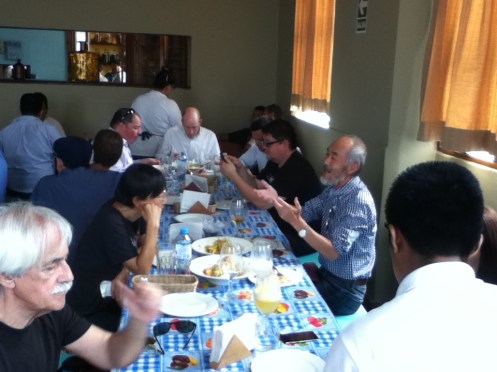
Peruvian food is getting popular worldwide, and Lima has its share of super trendy restaurants run by superstar chefs. We wanted to get a glimpse of this scene without breaking a bank. One memorable meal was at Isolina Restaurant. There was a long line at the door when we got there, but we were able to get a seat after waiting for about 25-30 minutes in a cramped bar area sipping pisco sour. It was not cheap for Lima standard, about $25-35 per person, but the price did not seem unreasonable considering the high quality of food.
IMG_0485
lunch at Isolina

Mercado Artesanal, a huge handicraft market, happened to be across the street from our apartment. Whopping 45% of Peruvian population is indigenous people, and they produce handicrafts in the villages. We stopped by here several times to stock up on gift items. The merchants there were not too aggressive and they let us browse without too much pestering.

We flew out of Lima on Jet Blue to Florida.

Update: December 2019    

We were back in Lima, twice, almost exactly at the same time of year – 3 years later. First was another cruise stop. This time they shuttled us from the Callao port to a shopping center closer to downtown.

I had a very specific goal this time: go back to the artisan market and get more colorful pillow cases. The cab driver dropped us off in the middle of a huge market zone where most shops were closed for some kind of holiday. I had to jog my memory to figure out where exactly was the spot, and, eventually, we found it. They now had more higher priced items such as pashmina scarves and leather handbags than $1 knickknacks. Merchants learn quickly.

In fact, the whole city looked much cleaner and upscale than 3 years ago. That frequently means better quality of life, I suppose, but, at the same time, higher price tags.

Streets were blocked off for traffic clearly in preparation for a parade. We never found out what the occasion was. I did try to ask, but I could not understand their perfect Spanish.

Lunch was at an excellent – you guessed it – sea food restaurant called Barra Maretazo. Fresh. Fresh. Reasonably priced.

We walked around the Miraflores area in order to digest our meal.  Christmas was definitely in the air.

In the Miraflores Park, there was an art fair going on. Maybe related to the parade??

Music and dance, too.

People were starting to have lunch as we had already done so according to American sense of time.

A modern church quite suitable for the high rise apartment dwellers of modern Lima.

We had a 16-hour layover in Lima on our way back home at the end of our 3 week journey in Chile, Argentina, and Uruguay.

We rented an Airbnb apartment for the night not too far from the airport. While on the cruise, I had noticed the ship was offering a shore excursion package priced at close to $200 for visiting two private art museums: Larco Museum and Osma Museum. Curious, I checked and anybody could go to these museums by paying not too outrageous ($8 with senior discount at Larco) admissions. Luckily, Larco was to open on Christmas Day while Osma was not. So I bought the tickets online & that’s where we went.

The collection was started by Rafael Larco Herrera, a Peruvian politician, businessman, and philanthropist, in 1925 with 600 pieces of pre-Columbian art that be bought from his brother-in-law. His son Rafael Larco Hoyle started a museum with this collection in honor of his father.

First thing first, we were hungry. The restaurant at the museum was just perfect: A beautiful garden setting, impeccable service, wonderful food, and the price tag not matching all that. I’d go to this museum just to eat and hang out!


Their collection was very well organized, labeled well in 6 different languages, and was beautifully presented. What I liked the most: it was not overwhelming like at some great museums of the world.

Sense of humor was also present.

It was interesting to be able to look in on their storage space.

If we end up in Lima again, I’d do two other things: marked in purple on the map


Machu Picchu & Aguas Calientes

January 2016 (by YK)     Itinerary Link

Machu Picchu as we saw:


Why?

I’d seen pictures, I’d heard bits and pieces about how special it was, and I knew I wanted to go see it with my own eyes. At the same time, I did not want to know too much about it in advance so that I could “feel” it as I enter the site.

And the first thing that popped into my mind as we walked into the goround of Macchu Picchu was a question: why? Why here & what for? It was pretty well hidden locationwise, but, the whole complex spreads out quite a bit that it could not have been a secret hangout of any kind. Why would mighty Incas choose a secluded place like this and build a whole village?

According to Wikipedia, it was built in 15th Century, and, if so, that seems to be relatively new in the league of the ruins of old civilizations around the world that are frequently thousands of years old. Yet, nobody is sure why it was built. Many researchers do believe it might have been a country resort for elite Incas. If it was, then the idea of leisure for the ruling class or rich and famous of Inca Empire was more spiritual than decadence, I concluded. I am sure they had their fun in thier lives, but not here.

machupicchua3PachuPicchu1machupicchua2

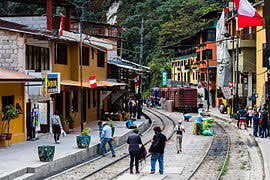
To get to or from Macchu Picchu, one has to go through a little town of Aguas Calientes. My guess is this once was a charming local village filled with peace and quiet. Those days are long gone. There were over 1.4 million visitors to Macchu Picchu in 2017 alone.  I didn’t think it was as bad as some people said it was, but it could have been a destination on its own right if there had been a far sighted planning involved. Easy for me to say, I admit.

We stayed one night at a small riverside B&B called Terrazas del Inca($60), and it was quite adequate. Free breakfast was helpful the next morning so that we were fueled up to tackle the main attraction, Macchu Picchu. Our dinner at the Tree House restaurant was very good once we survided climbing up all the stairs to get there.

aguasCalientes-peru

How we did it:

Caution: Bring your passport to buy the tickets of all kinds and to get into Macchu Picchu.

Getting into Aguas Calientes: We took the train out of Cuzso. under 4 hours, $202 roud trip in January 2016.

1. We made a reservation online at the Peru Rail site & had to pick up the tickets at a Peru Rail office in Cuzco. Be sure to bring the same credit card that you used to make the reservation. There are 3 different levels of train/service you can choose from: Expedition is the entry level, Vistadome has big windows, and Hiram Bingham is the super luxrury with gourmet meals and all. Ticket prices change depending on time, season etc. We chose Expedition, and it was fine. We got the same scenery as others. Vistadome can be at least $20 more expensive. Hiram Bingham can be over $500 each way.

2. We took a taxi to Poroy Station, 13 km away from the center of Cuzco. This is where you get on the train to Aguas Calientes. There is nothing much around the station, but a marching band was brought in to entertian the tourists when we were there. Possible to get snacks and drinks at the station.

3. From the train station in Aguas calientes, you can walk to most hotels.

– An alternative to using the trains: join a guided hike of the Inca Trail, a 2+ day trip. There are many tour companies who do this. You can search online. Costs seem to be $200 & upward. You can also get this arranged once in Cuzco.

Park Tickets: You can find out how many tickets are avaialble for a given day on the official website, and this is good to know since only 2,500 people are allowed in each day. Forget getting tickets online, though. The site is very slow to load & hard to navigate through. The first thing we did after arriving in Cuzco was to line up to get the entrance tickets to Macchu Picchu at the Ministerio de Cultura office near the main square. It took 20-30 minutes to get to the front of the line, but it was not too painful. We paid about $40 per ticket except one person who wanted to do the Huayna Picchu Mountain, and she paid about $20 extra. Nowadays, the tickets cost over $60 each, I hear.

Getting to Macchu Picchu: One can either take the shuttle bus(runs from 5:30 AM to 9 PM) or walk. We took the shuttle. The bus depot is by the river & anyone can point it to you. There is a ticket booth, and you basically wait in line for your turn to get the tickets and to get on the bus. For us, it was $14 round trip, but, now it is $12 each way, it seems. When you are on your way up, you will be glad you are not walking. It is a stiff climb for the 30 minute bus ride.

Touring the park: You walk. I’d read the tour groups come between 10:00 and 14:00, so we went there before 9 AM and it was quite comfortable. There is quite a bit of going up and down within the park, but it is never a serious hike. We spent  about a couple of hours or so, and we had covered most of the sites. By the time we left, the park was jam packed.

Some people choose to stay at the Sanctuary Lodge, the only hotel in Macchu Picchu. We were not tempted not just because it was $450/night back then, but we thought we could see enough of it by just visiting for a few hours. We did not change our mind after visiting

Getting back: We got on the shuttle, came back to Aguas Calientes, had lunch, walked around, then got on the train back to Poroy.

Hire a guide?: One can hire a guide by the park entrance. The guided tour typically lasts about 2.5 hours, and cost between 30 to 50 soles($10-$16) depending on the size of the group. We did not hire a guide. we might have learned more from a guide, but we liked to browse on our own pace.

Israel: Haifa, Jerusalem, Acre

September 2011

CIMG0916

Wednesday, 9/7

We docked at Haifa yesterday at 1pm. After lunch (for, me Cajun seafood gumbo, quail with pomegranate glaze, and a brownie sundae with chocolate and caramel sauce,) we set out into the city. We took a tram to the top of Mt. Carmel, overlooking the harbor, and visited the Carmelite church Stella Maris. From there we walked along the side of the mountain to what yk referred to as a subway, but which was really an underground cable car, and traveled father up, looking for views. On the way down we came upon the beautiful Bahai gardens and temples, but they had closed for the day. We continued down, taking staircases and alleys, back to the ship, which, by the way, is easily the largest structure in the city.

Haifa is not a particularly clean or attractive city.

Today we took the train to Acre, continuously occupied since the days of the Phoenicians. It was the headquarters of the crusaders, specifically the Knights Hospitallers and the Knights Templar, for over a hundred years.

We visited the fortress of the Hospitallers and the tunnel of the Knights Templar. The story is that the Knights Templar were the precursors of Western Union. Pilgrims traveling to the Holy Land did not want to carry large sums of cash overland, so they would deposit the cash with the Templars and pick it up, less a large commission, in Acre. Since they were handling large sums of cash, the Templars built a tunnel from the harbor to their fortress so the cash could be transported from their ships safely.

Tonight we sail to Ashdod. Yk and I will catch a bus to Jerusalem and spend the night in a hotel just outside the old city.

Friday, Sept. 9

We came to Jerusalem yesterday and walked around the old city. It consists largely of a maze of narrow covered streets with shops on both sides. Not at all what I expected. Very difficult to get one’s bearings.

street in old city Jerusalem

We did visit the Church of the Holy Sepulcher, the western wall and the Temple Mount, but couldn’t enter the Temple Mount because, for some unknown reason, it was closing.

Have to return to the ship early today as everything, including bus service, shuts down midday on Friday.

israeltaxi

We figured out our problems with old Jerusalem. We had taken a cab from the port to the bus terminal in Ashdod, a bus to Jerusalem, and another cab to our hotel outside the old city. We entered the old city late morning, not by the gate we intended. As a result, nothing we were looking for was there and we found ourselves lost in a crowded maze of covered streets, no idea where we were. The place is not large, but it’s impossible to get perspective.


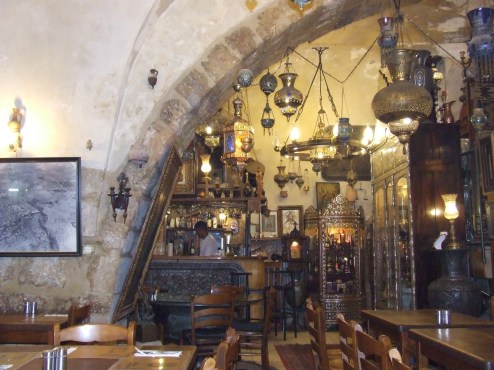
Armenian Restaurant in Old City Jerusalem
Armenian restaurant


We finally figured things out to some extent, had lunch at a lovely Armenian restaurant and located the sites I’ve mentioned earlier.

damascus gate

This morning we entered by the Damascus Gate, our intended gate and found our way around much more easily. We returned to the Holy Sepulcher, which was much less crowded in the morning, and were able to walk around for a while. The church has lots of different nooks and crannies and a number of different levels, none of which were evident yesterday. We located the site of the crucifixion, which is inside the church, but the line to enter the tomb was still forbiddingly long,

I’m sure the financial model of the cruising industry is heavily dependent on shipboard sales (they certainly aren’t making much money on the fare we paid for this cruise.) There’s a casino, several high-end shops, numerous bars and specialty restaurants which require an extra fee. All of these can be avoided if desired and drink and wine prices are generally reasonable (one can purchase a nice bottle of wine at dinner for $30 – $40 and spread it over two dinners.)

I think the big profit item is shore excursions. They are pushed hard and are expensive, but also very convenient. Most of our ports are some distance from the places people want to see, Nazareth, Bethlehem, Galilee, Jerusalem, the Dead Sea, etc. and prearranged transportation and a guide would be very helpful.

Being cheapskates, we went to Acre and Jerusalem on our own. Probably our biggest problem was dealing with Israeli cab drivers who seem to range from merely shady to crooks. You know you are going to get ripped off, the aim is to keep it reasonable.


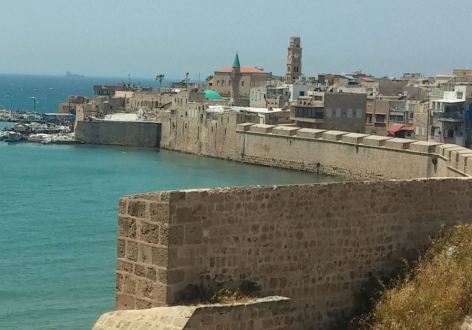
israel-acre
Acre


Our experience in Acre wasn’t too bad. We couldn’t find the bus to the old city, so we took a cab. No meter. When we got there, a relatively short ride, we were charged 20 shekalim, about $5.50. Not too bad. On our return trip, however, again no meter, we were charged 14, barely more than bus fare would have been. At this point, we ran out of honest cab drivers.

The cab drivers at Ashdod were interested in selling all day tour packages. We just wanted a ride from the port to the central bus station. One guy agreed to take us to the bus terminal for 50 shekalim, which seemed like a lot, but we were splitting it with another couple and wanted to get started. During the ride he continually explained how we could save time and money if we would let him take us on an all-day tour for 200 euros, just “50 euros each.” There were no takers.

In Jerusalem, the first cab we approached to take us to our hotel wanted 75, explaining that it was a long a tricky trip, which I knew to be false. We walked away. The next guy said he would charge the meter, which was the first time I had heard of a meter. Once in the cab, I saw no meter and he took a long roundabout route, explaining that he was avoiding traffic. Once we got there, he opened the glove compartment and, low and behold, there was a meter displaying 60. For all I know it displayed that from the time we entered the cab, but it was at least better than 75.

We avoided any other cabs in Jerusalem with the help of the lady at the hotel who wrote down central bus terminal in Hebrew and Arabic and a very nice young man in the traditional Hebrew garb of black suit over a prayer shawl, who walked us a long way from the wrong bus stop to the right bus stop.

Our real scammer was our last ride in Ashdod. We took the cab from the bus terminal back to the port. As usual, there was no meter, but I assumed the guy was aware we had already taken a cab the other way. When we arrived at the port, I asked the fare and he said 20. This puzzled me, I knew it was too cheap. Then he added “euros.” When I indicated I was paying in shekalim, he demanded 100. I said no way, handed a 50 and got out.

All in all, I’m not sure the trip to Jerusalem was worth the hassle, but was something we had to do. There’s only so much you can take back from crowded tourist spots.

Sat., Sept. 10

We are back on Homer’s wine-dark sea. After 4 days in one port or another, I appreciate the sea day. Nothing to do but decide when to eat and where to sit when you’re not eating. We attended a lecture on Ephesus by the resident historian and did little else. Enjoyed two for one drinks from 4 to 6.