The most memorable thing about Kanchanabri(population: 32,000) was this songthaew & the driver whose name we can’t recall. We decided to take the bus there simply because the buses ran every 20 minutes or so vs. twice a day for the trains. We caught our bus at Bangkok’s South Bus Terminal, which, for some reason, was out west, not south at all. This bus terminal was huge. You took the escalator up to the second level and found zillions of ticket counters. Confused, we just looked for the word “Kanchanaburi” and got our tickets. The 2.5 hour westward bus ride was unremarkable. At the bus station in Kanchanaburi, we were picked up by a driver who was not overly aggressive. “Please take us to Away Resort!” So off we went. We chose this hotel mainly because our friend Sam had Hotel.com reward points that he wanted to spend and Away Resort came up as one of the choices when he did the search. It was a bit out of the way but very quiet.
On the way to the hotel, we talked with the driver, and he was very pleasant. He said he could show us around. We said the Kwai Bridge and anything else he thought we shoud see. Sorry, but we can’t remember all the things we did. Here is some of what we found:
Enough. We had to stop. I think we paid him about $50. Then we all plunged into the nice, big pool at the hotel. Let’s just eat here, someone said. The restaurant at the hotel had great food and was peaceful.
Next morning, the hotel arranged an airconditioned van for us to go to the Erawan Falls in a National Park 65 km north of Kanchanaburi. It was a big park, and we had to hike up quite a bit to see each level of the 7 cascading falls. The scenery was beautiful, but the sun was scorching down. None of us made it to the top tier. Some of us got to level 5. Pat’s feet were being massged by some fish nibbling at them.
We had lunch at a cafe by a dam on the River Kwai (Khwae Yai River in Thai) before heading back to the Kanchanaburi bus station. I know. We don’t have pictures of the beautiful water falls, but we do of the bus terminal, below.
It would have been nice to spend a couple of days just relaxing at a resort hotel around here. There are some other national parks in the area, too.
The biggest city in the world around the year 1700 had a population of over a million, and guess where this city was: in Thailand. Where is that, you may wonder. Ayutthaya, only about 80 km north of Bangkok following the Chao Praya River. You can get there by train in 90 minutes.
The Bangkok Railway Station(also called Hua Lamphong station) is in downtown Bangkok. This is where you get the train to Ayutthaya. We arrived at the station around 9 in the morning, bought our tickets, and quickly discovered that there were not enough seats in the waiting area. We went upstairs to a cafe.
The train ride was uneventful. Once we arrived at the station in Ayutthya, the four of us got on a tuktuk, mainly because the driver approached us with a nice smile. He took us to our hotel, the Klong Suan Plu Resort. It was a bit outside of the city close to the river. Quirky is the word that came to mine as we entered the place. Why they chose to have all the super heros flying around the property was not clear, but it was fun. “Resort” was a stretch, but it worked for one night. If we had known better, we’d have stayed closer to town, though.
There are many hotels within the island
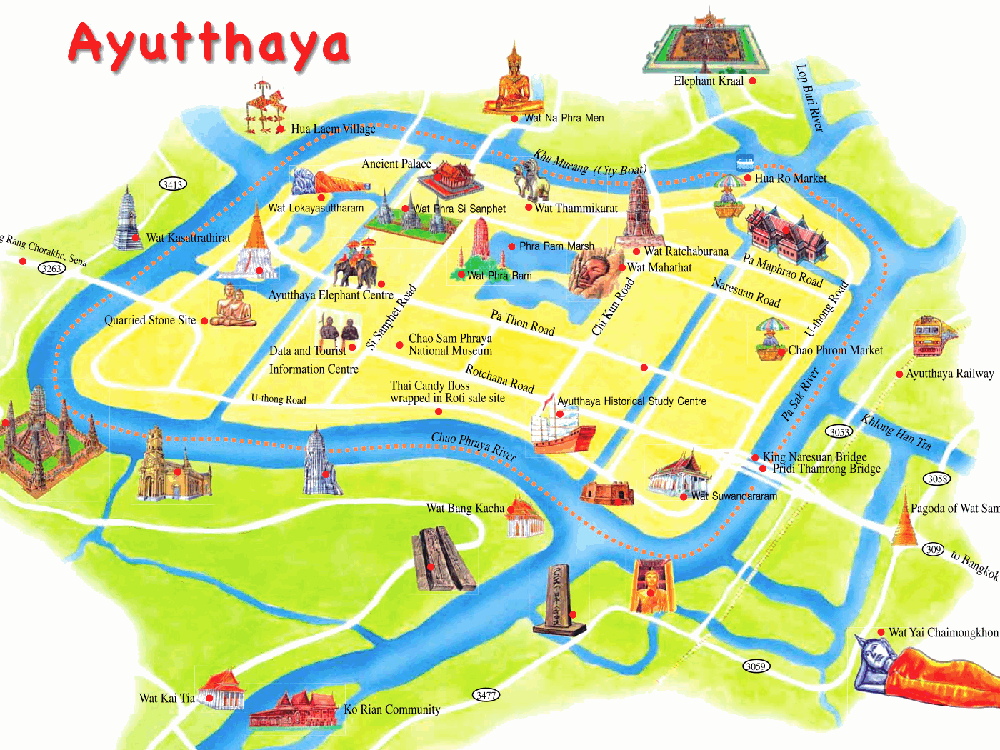
As you can see on the map, there is too much to see. We hired the tuktuk guy for the day(we paid about $30/day) and let him take us around. First thing first, lunch. He took us to a restaurant nearby, then we were ready to head out.
Temples. Then more temples.
Our driver was eager to show us more, but we had to stop. We could not keep track of all the temples. Please take us to an airconditioned cafe or restuarnt to take a break. Where did we end up? Back to the railway station. There was a nice resturant called “the Station” there.
Can we see the sites from a boat? Of course. The driver got arranged for a boat, and we let the temples and the palaces slide by us as we were comfortably sitting down.
As we exited the boat, our driver said we had to hurry to catch the sunset and there was one particular spot where we would get the best view.
All the temples were lit up, and the whole town looked very pretty. You can visit Ayutthaya for a day from Bangkok, but, then you would miss this!
We asked the tuktuk guy to drop us off at a restaurant near a night market(nothing special about it) and a massage place(good and cheap) and then to go home. He insisted on waiting for us. We begged him to leave as we went in for a massage. He finally did, and we took a cab home after a blissful treatment.
Next morning after breakfast the tuktuk man picked us up and took us 20 minutes down the river to the former summer palace of Thai royals in Bang Pa-In. In the picture above, our friend Sam is modeling how long a woman’s dress or slacks should be in order to be attired properly to be admitted to the palace grounds.
It was interesting to note that there were lots of European touches in this complex which was rebuilt in the early 1800’s. Sorry but I can’t find the pictures we took. We did rent a golf cart to save our steps, and it was fun driving the thing.
We caught the train back to Bangkok from a station nearby rather than going all the way back to Ayutthaya. Not every train stops here, but we lucked out and did not have to wait long. The tuktuk guy knew the train schedule, and that helped.
While staying in Bangkok, we took a 3 night trip to one of the old capital cities of Thailand, Chiang Mai(founded in 1296.) The flight was an hour long going north and cost $25-30 each way(found on skyscanner.com) on Vietjet and Nok Air. Never heard of these airlines? I know. But short flights are pretty much all the same around the globe. Chiang Mai Airport is 20-25 minutes southwest of the city center. The Chiang Mai area has a population close to a million, which makes it second only to Bangkok as a metropolitan area. But the city proper has 160,000 inhabitants, and the feeling you get as you enter the city is “manageable.”
Chiang Mai is notorious for bad air in the spring. From late February to early April, the post-harvest rice and maize (corn) fields are set ablaze round-the-clock in order to clear the land and, at the same time, fertilise the soil in preparation for the replanting of crops ahead of the rainy season. Smoke and dust resulting from the burning pollute the air big time. We did notice some of it, but it did not seem too bad. Maybe we arrived right after they finished doing most of the burning.
It was already dark when we checked into the hotel, and we decided to walk to a branch of the restaurant that we liked in Bangkok, May Kaidee. Like many other towns in Thailand, there was a maze of alleyways and narrow streets.
Chiang Mai has lots of small (what they called) “boutique style” hotels and B&B’s. Ours was located between the square area(old town) and the river & called “Chedi Home.” It served a wonderful breakfast, shown above. We looked forward to breakfast every morning. One could find a decent place for $40-60/night.
Our room was rather tight, but it was clean and comfy. There was a small swimming pool at the hotel, too. It was tempting after returning from a walk, but we did not jump in. Five of us were traveling together, thus, we ordered a songthaew( think of it as a big tuktuk) whenever we went somewhere in order to stay together and travel in one car. Can’t remember the price, but it was reasonable.
The first stop on our first morning was the Doi Suthep Mountain and the temple on top of it, Wat Phra That Doi Suthep. The drive up the mountain lasted only about 15-20 minutes. Gold, gold, gold. Seeing gold in a major temple in Southeast Asia is normal, but this was quite something.
Their own emerald BuddhaTheir version of a reclining Buddha
People usually combine a visit to a local village with this trip, but we chose not to do that. Peeking into someone’s house would make us feel we were imposing a bit much. Of course they welcome visitors, and they make a living that way. Still, it was not one of our favorite activities.
We asked the tuktuk driver to let us off at the northwest corner area on this map where there’s a more modern shopping district(Nimman) with lots of shops and restaurants. Our lunch was at a French-Thai restaurant called Leon de Nimman. Great food, not too expensive, fun decorations. After lunch, we walked around the area for a while and went back to the hotel to rest.
Chiang Mai area has over 300 temples. After a break, we were rejuvenated enough to explore the old city area and drop into a couple of them. We used tuktuks to move around within the walled old city area to save our energy for the evening. After a while, all the temples merge into one huge ball of memories, and the ball remains rather fuzzy.
Dinner was at one of the food courts in the Night Bazaar area south of our hotel. The rain was coming and going all day, and it really poured down as we entered the covered food court. Great variety of food at a good price(not too cheap because it was aimed for tourists.)
We decided we all deserved a good massage. There were plenty of massage places in the food court area and along the main street that ran though the night market.
The next morning our songthaew driver took us to Lampang(population: 58,000), a town 10 km southeast of Chiang Mai. We first went to the Dhanabadee Ceramic Museum where the process of making the famous bowls decorated with a chicken is explained. Their store had lots of beautiful but slightly imperfect plates and bowls at really cheap prices.
Lampang is famous for horse drawn carriages because they are still used as ways to get around, unlike other places where only tourists use them.
Some of us took a tour of the city on a horse carriage and saw some old wooden houses in Burmese style.
We had a surprisingly wondeful lunch at Tuk Pak. We were treated to a gourmet meal at a very reasonable price as recommended by the manager/owner who spoke English. As I tried to check the information about the restaurant just now, it seems it is no longer in business. What a loss!
After lunch we walked around and found some bargains in the local market area. We visited the temple below before heading back.
Wat Pongsanuk was recommended to us by a Thai friend, and it was definitely worth a visit.
We did not feel like a full dinner so we went back to the food court at the Night Bazaar. Afterdinneralong , we walked to the Ping River and strolled until it began to rain heavily. We quickly got in two taxis and headed back to the hotel.
Our return flight was late in the afternoon, so we would have another full day in Chiang Mai. We visited the old archeological site Wiang Kum Kam, about 5 km south of the city. We hired horse-drwn carriages to look around the area which was once the capital of the Lanna Kingdom before Chinag Mai took over the honor. This area then became submerged under the Ping River. It had become a legend until it was accidentally rediscovered in 1984.
Our lunch was at the Hen Jai Yong Restaurant as we eaded to the airport. The menu was extensive, but we did not know what to order. Luckily, some Thai Americans were sitting next to our table. We copied their order. Great food. Quite reasonable.
There was an art gallery on the restaurant grounds which was perfect for our purpose of killing time. There were several different shops selling ceramics and wooden craft items. We bought a beautiful candle holder that graces our living room now.




 Small Wide World