Two young men served as our camel wranglers. They helped us onto the camels, tied together the camel train and led us off into the desert.
As we were trekking south, the sun was setting on our right, producing interesting shadows on our left.
At one point we passed a nomad encampment
Before reaching our camp we stopped at a dune to watch the sunset. We did some sand surfing and waited for the sunset.
After the sun went down, we mounted our camels and rode the rest of the way to our desert camp.
We settled into our tents, which were equipped with showers and toilets, then headed to the dining tent for dinner. Much to my surprise, they served wine. In the entire previous week in Morocco we had not eaten at any restaurant that served alcohol.
We felt a bit guilty about the luxuriousness of the tents.
After dinner, we found a roaring campfire just outside. Local music was played by the staff and several of the 20 or so guests sang songs from their native countries. It was an invigorating experience.
The night sky was incredible.
We were up early the next morning to view the sunrise. The bright star in the photo is Venus.
We then packed up, had breakfast, mounted our camels, and headed back to civilization.
YK has arranged for a 4 day, 3 night desert tour that would pick up the 7 of us and eventually deliver us to Marrakesh. In many ways it was the highlight of our Morocco adventure.
Heading south, our first stop was the town of Ifrane (population: 73,500). It is modeled after a Swiss village with lots of expensive Swiss styled houses. It even features the Lucerne lion carved into a stone.
After our stop in Ifrane we continued south for a short while, stopping in a grove of cedar trees outside the town of Azrou. The grove is inhabited by a band of monkeys (actually Barbary Macaques). They are not native to the area but were introduced and make a very nice living from the food donated by a stream of tourists.
From Azrou we continued south, on largely empty roads, for several hours with the Atlas Mountains in the distance.
We stopped for lunch at a roadside restaurant in the middle of nowhere.
Again, we continued south, stopping a few times at lookout areas.
Late afternoon we reached our hotel at the edge of the desert.
the rooms were spacious and comfortable; you could even get WiFi signal if you stood at the right spot in the propertyand the food was decent
We began the next day with a stop at a Berber village for some traditional music.
Gnawa music
Next we drove out to and onto an ancient lava bed.
lake Dayet SarjiBill brought out his frisbee.
We spent the rest of the day visiting some small desert towns where we had lunch and the opportunity to shop for spices, fossils, clothes, and, what I call, camel handlebars.
a lunch at this restaurant was quite goodespecially this type of pizza
Late in the afternoon we were dropped off at the camel lot for our trek to the desert camp.
After our one night in Chechaouen, we headed to Fez. As before the six of us had a hired car, and Bill, once again, set out to find a shared taxi to Fez. This time he was not so fortunate. There seemed to be no one else headed to Fez and Bill wound up taking several buses, arriving much later than we did.
The drive to Fez was similar to the prior day’s drive, but longer(3.5 hours). We asked the driver to make a lunch and bathroom stop and he pulled into a service station with what we took to be a restaurant behind it. We entered a large room with scattered plastic chairs and tables and a small room off to one side. In the small room was a counter dispensing coffee drinks and a cooler with assorted cold drinks. In the main room there was a stall that appeared to be a butcher’s shop. No sign or waiters or menus.
We pulled some tables together and sat down to see what would happen. Nothing happened. When it became evident that there were no servers or menus, I approached the man behind the butcher’s stall. It became evident that my French would not be helpful either. I pointed to a pile of lamb chops and held up six fingers. With nothing else to point to and conversation apparently not possible, I returned to the table.
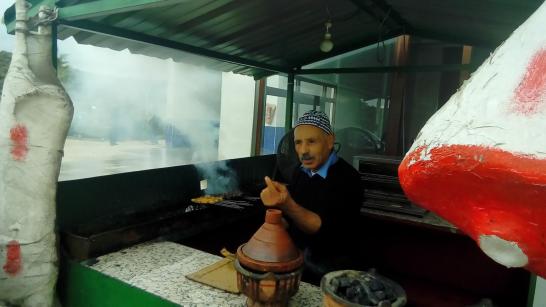
tajine in front, grill in the back
Sometime later, a man approached and asked if we wanted the lamb chops in a tajine. Not knowing what else to say I said yes. The next visitor was our driver who informed me that a tajine would take 45 minutes and he didn’t want to wait that long. Neither did we. We switched to grilled. They were small but delicious. I still have no idea what else might have been available. We ended up paying about $6 for this meal. If we had time, we could have ordered more to eat to our heart’s content.
“the BEST lamb skewer I’ve ever had!” one of us had declared…
Fez:
We arrived in Fez (population: 1.4 million) late afternoon. We stayed at a modern Airbnb apartment outside of the old town section. Our host showed us around the apartment, arranged a tour guide for the next day and recommended a Turkish bath or hammam. The previous two nights our apartments were cold and no one had felt like showering. The idea of luxuriating in hot water was very appealing.
As it turned out, that’s not what a Turkish bath (about $10) is. We started in a sauna to work up a sweat, then went to a massage table where we were washed with soap and water and then scrubbed down with an abrasive glove, think sandpaper. A layer of dead skin and, I think, several layers of live skin were removed. Certainly felt clean afterwards.
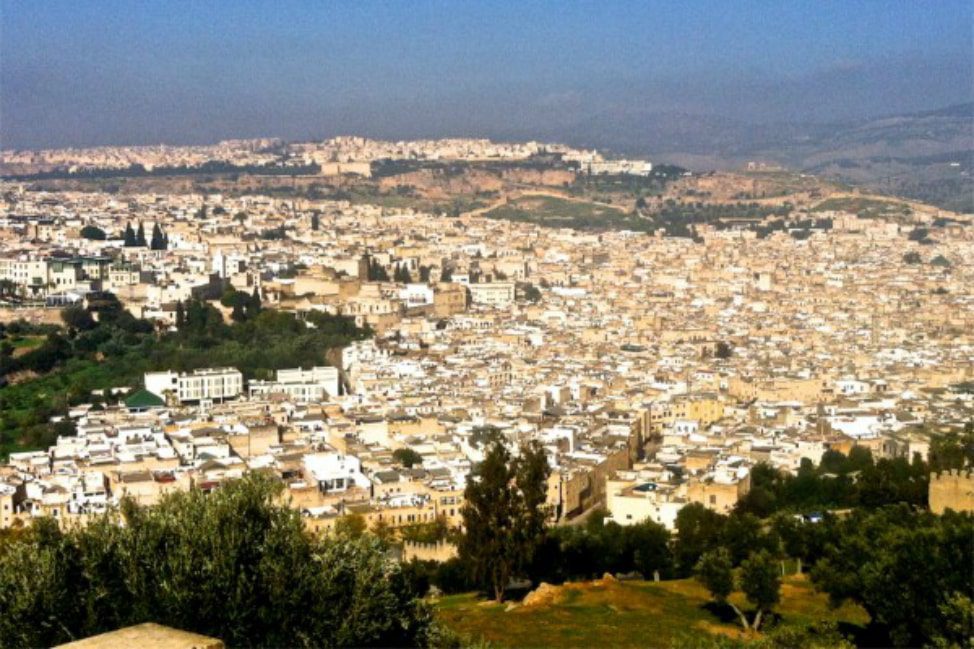
The next morning we had arranged for a tour (about $150 for a full day of driver and a guide) of Fez and the medina (old quarter). Before entering the medina, we visited the outside of the old palace and took in an overview of the city. We also noticed the many storks on the rooftops of the city.
a door to the old palace
Our guide told us about the meaning of their flag: red means blood, green means peace and love etc. The official explanation for the color of red seems more tamed (strength, valor), but he said their independence in 1956 was earned after shedding lots of blood, and the flag reminds them not to forget that.
storks on rooftops
There used to be a sizable Jewish community in Fez, and this is the area where they lived.
The medina is a warren of streets and alleys, some quite narrow. It is very easy to get lost, and we were glad to have a guide leading us. It is believed that over a million people and 10,000+ businesses occupy the medina.
We did go to the world famous tannery, but nothing much was going on because it was not the right season.
the tannery in slow motionAl Attarine Madrasa
And, of course, our guide made the obligatory stops at various high end shops. Ceramics, textiles, and carpets.
the tour ended at the Blue Gate
We basically had one full day plus an evening in Fez, and we did get to taste the highlights of the city. Maybe we will try going to the medina on our own next time, get lost, and fight our way back through the aggressive shopkeepers. Will that make us feel a little more than pure tourists? Somehow I doubt it.






 Small Wide World