October 2019

We signed up for a 10 day tour of China and Japan in fall of 2019 (thanks to a travelzoo.com email) basically to see Kyoto, the old capital city of Japan (from 794 to 1869). Isn’t that a rather convoluted way of doing it? Well, because it was – you guessed it – cheap (about $1,200pp including tips). If we had gone directly to Kyoto on our own, we would have spent that much or more. And we got to see some other places we had never been before: Wuxi in China, Nara and Mt. Fuji in Japan. I devised a two day itinerary for Kyoto because we were pretty much on our own in Kyoto, a city of 1.5 million people that is better experienced on foot and by public transportation at one’s own pace. Unlike Tokyo or Osaka, Kyoto was not heavily bombed during WWII for the sake of protecting the cultural assets. Thus, there remain more of the old things and the way of life to be seen in this city.

Day 1:
We first went to a subway station nearby and bought 4 of the Day Passes (JPY 600 = under $6) for unlimited bus rides for the two of us for 2 days. With these passes and the Kyoto bus route site/app in hand, we were ready to hit the streets. They have bus+subway day passes, but we chose the bus only option because we preferred to be above the ground and see outside. Their subway has only two routes, and, you’d have to pay separately for all other train rides. This may sound confusing, but there are many different bus and train companies operating in Kyoto. The bus pass covers all the buses except the suburban routes.
Our hotel that came with the tour package was located two stops on the subway south of Kyoto Station in a quiet neighborhood. If I could have it my way, I would have chosen a place nearer to Kyoto Station or more north of it on either side of Kamo River to get around more efficiently and be closer to the center of things.

Our first stop was Arashiyama Bamboo Grove. From Kyoto Station bus terminal Bay 6, we got on the bus #28 and went for about 44 minutes to Arashiyama Tenryuji Mae (Tenryuji Temple) stop. I chose to go there first thing in the morning in order to beat the crowd, and it looked like we succeeded when we arrived there a little before 10 AM.

But the solitude lasted about a minute or two. Trails were well marked, but we basically followed the crowd. We were not sure whether it was a seasonal crowd or always like that.
We hit the autumn tourist season when we were in Kyoto, thus, we had to compete with throngs of people especially school excursion groups. It was a bit annoying and amusing at the same time, but it was good to see people young and old enjoying themselves.

We could have joined the kimono-clad crowd by renting one, obviously.

We took anther bus (one transfer) and arrived at Kinkaku-ji, the Golden Temple. Nobody knows exactly how many, but, there are at least 1,600 Buddhist temples and 400 Shinto (an indigenous religion of Japan) shrines in Kyoto according to my quick research. Every corner you turn, there is a temple, almost. Kinkaku-ji is supposed to be one of the two most beautiful of all the temples in this city.

By this time, we felt we could handle the bus system of Kyoto quite well. Buses were efficiently run and the routes were quite extensive.

Our next destination was to be Ginkaku-ji, the Silver Temple. The bus (35 minutes with 1 transfer) was routed on the app, and we hopped on the bus with confidence to go across town. But Pat had a knee pain and could not continue walking too much. So we had to give up on Ginakaku-ji. However, I will pretend that we did everything as planned and record the entire trip according to the original plan.
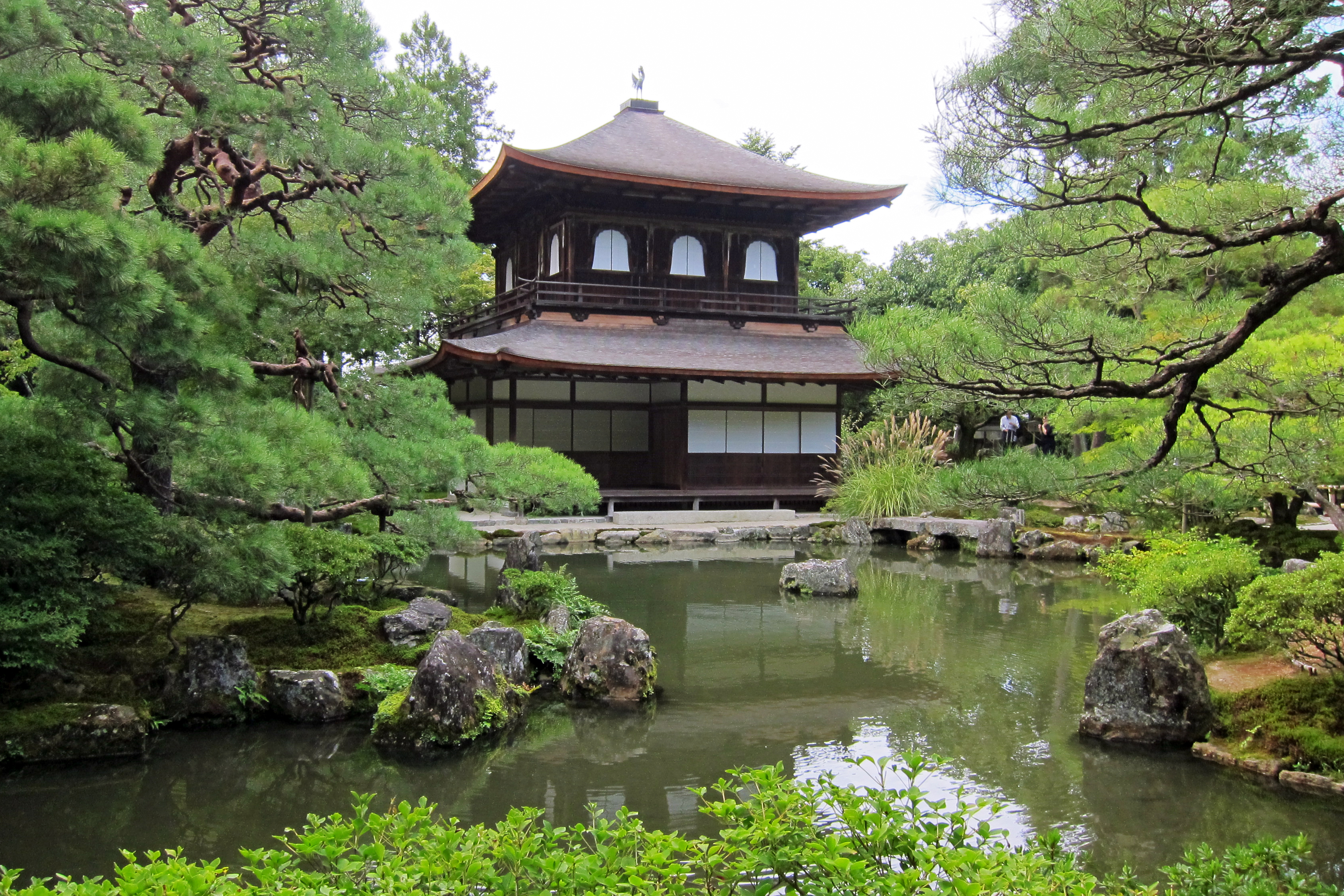
We had lunch at Fuka Ginkaku-ji before entering the temple. The Silver Temple looked more black than silver. Then we walked on a pedestrian only walkway along a canal called Philosopher’s Path (about 2 km long). If we had not eaten, we could’ve had a bowl of udon noodle soup at Omen Ginkaku-ji along the way, but we were not hungry.
We slowly strolled on the path for 15-20 minutes or so, and we turned right to get back on the main road (then turn right on the main street toward a bus stop – keep in mind that the cars drive on the left side in Japan ) to take the bus #204 to go to Kyoto Handicraft Center (Kumano Jinsa stop on the bus) for high quality souvenir shopping.

It should be an easy walk from there to the next stop: Honke Nishio Yatsuhashi – a rather long name for such a simple pleasure – a matcha green tea ice cream!
As we finished the afternoon snack, we entered Hanamikoji Street, an old housing area in the famous Geisha district of Gion. Ladies who dressed up like Geishas strolled along with us.

The street ended by a temple, which we entered. On the street on the south end of the temple was the World’s Smallest Ukiyoe Museum, a tiny museum of woodblock prints. Too bad that it was not open for us.

We could have walked around the area more and gone to Teppan Tavern Tenamonya for grilled fish and meat dinner. But we were tired, thus, we went back to the hotel and rested a bit. We ended up at a sushi joint in the neighborhood, and that was fine.


The area we stayed in had narrow alleys and some traditional businesses such as a public bath, pictured below.


Day 2:
We started this morning at the Fushimi Inari shrine. If the Golden Temple was the most popular among the temples, this is the most popular among the shrines. We tried to get there before the tour buses started arriving en mass, but there were enough people there already at 9 AM. It is open 24 hours and free to enter.


We took the train from the station right down the road from the shrine and went 4 stops north, then, transferred to a bus and went two stops east. Sounds complicated? Actually this was done in 20 minutes. Then we had to climb a hill to reach the other “most beautiful temple” in Kyoto: Kiyomizu-dera temple. Unfortunately, much of the major structures in the temple ground were undergoing a renovation & we did not go in.

The reputation lived up to the hype, and it was beautiful just to look in from the outside.

We slowly continued our walk down on two ancient alley ways: Sanneizaka and Nineizaka. We continued walking till reaching yet another temple, Kodaiji, a temple of Zen Buddhism. Its Zen garden is well worth a visit.

When we exited the temple, we walked west to reach a major street to catch a bus: #80, #84 or #207, went 3 stops, got off at Shijo-Kawaramachi stop. We crossed the street (Shijo Street) to enter Nishiki Market, a 400 year old food market in central Kyoto. (Actually, you enter the Teramachi Street shopping area to reach Nishiki Street that is a cross street & it runs parallel to Shijo Street.)

Known as “Kyoto’s Kitchen,” there was no shortage of saliva inducing foods on display at Nishiki.

We ended up eating at a burger and beer joint, though. I wanted to try Japanese style burger, and Pat was ready for a beer after all that walking.
A few blocks west of the western end of Nishiki Market is a home cooking restaurant called Obanzai Taroya that I wanted to try, but we could not wait. Another restaurant I was interest in was Kichi Kichi Omurice. A childhood nostalgia called my attention to this place that specialized in omurice – fried rice covered with a Japanese version of an omelette. Growing up in Korea, the closest thing we had as a western style meal was omurice, a left-over from the Japanese occupation. Maybe next time.


In reality, we left Kyoto after lunch. If we had a whole day, this was where we would have gone next. Find a bus stop on Shijo Street and get on the bus #101, go 3 stops, get off at “Nijojo Mae” stop. We are NOT going to a temple/shrine. Nijo Castle, the home for Tokugawa Ieyasu, the most powerful shogun (a warlord) in Japanese history, is the destination.
On the way out & back to the Nishiki Market area, you can stop at Kyoto International Manga Museum to check out their collection of 300,000 comic books. Another fun museum to visit could be Samurai and Ninja Museum situated right next to Nishiki Market. You will have to pay up (about $30) for this interactive Samurai/Ninja experience, though.

Here’s a challenge for you: find this restaurant for a memorable dinner. Our local friend took us there, but the restaurant doesn’t have much presence in English language sites. I have the name and address in Japanese (希味: 室町通松原上る – 587), and it is marked on the map above. Their web site is in Japanese and shows some pictures of the menu. And there is a phone number so you can make a reservation. There is no signage of any kind outside on the restaurant building. You can kind of tell it is a restaurant, though.

We had a full course dinner. I lost count of how many courses came out, but each and every one was delicious. A “creative cuisine” is what they promise, and that is what you get with freshest ingredients. All for under $30 per person.


Yes, desserts are included, too!
 Now you may be in the mood for a nice cocktail. Hop on the bus or walk to L’Escamoteur for a creative night cap. If you still have energy, walk across the little bridge and continue for a couple of blocks and turn left. Stroll along slowly for 6-7 blocks up the road till you come to a canal. This is a really pretty area especially at night. Look at the map above and find the three streets (Shinbashi Dori, Shinmonzen-dori, Furumonzen Dōri) marked on the map and stroll along.
Alternatively, there is a bar street called Pontocho Alley north of L’Escamoteur, and you can get a drink there and cross over to the other side of the river and get to the three streets. Please refer to the map to figure it out.
Day 3+:
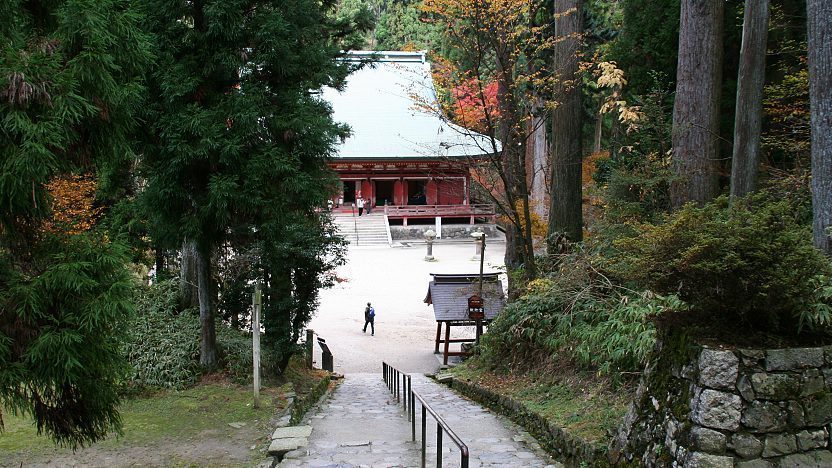
I’d venture out a little on the third day in Kyoto & go up to the Mt. Hiei area northeast of the city to visit a monastery named Enryakuji. This is how to get there:
Take the JR Kosei Line from Kyoto Station to Hieizan-Sakamoto Station (15 minutes, 330 yen one way), from where it is a 15 minute walk or 5 minute bus ride to the lower station of the Sakamoto Cablecar. The cablecar ride takes 11 minutes and costs 870 yen one way or 1660 yen for a round trip. From the upper station,
We have not been there, but the story of feisty monks up in the mountain intrigues me. There might be peace and quiet up there, too. Religion is supposedly more to do with spirit and soul, but, in actuality, there are power struggles and ambitious monks in temples (and churches, for that matter) around the world. Is greed a human instinct? Buddha did not mean to create an organized religion, but we humans did it anyway.
After a short time in what I imagine to be a mountain retreat, you can go back to Heizan-Sakamoto station and get on the local train (1 stop) to go to Ogoto Hot Springs by Lake Biwa, the largest fresh water lake in the country. Your body, especially your feet, will thank you for a relaxing soak in mineral water while your stomach will enjoy the freshest seafood from the Lake Biwa. Most hot spring resorts in this town offer day use of the hot springs bath & they will pick you up from the train station if you give them a call from the station. I found the prices of hot spring and food at this hotel reasonable ($20 for the bath). Fancier hotels seem to charge upwards of $50 for a day use of the hot spring with wonderful view of the lake.
Of course not everyone likes hot springs. Then there’s always more temples to see in Kyoto.

On the way back to the city, get off at Yamashina station and take the subway Tozai line, go 2 stops to Keage. Get off here and you have 3 choices:
(1) walk northeast for 17 minutes to Nanzenji temple, a Zen Buddhist temple.
(2) walk north a few steps to the next street corner & take bus #19 for 2 stops to “Jingu michi” stop. You can visit the two temples below conveniently located next to each other.
(3) from the same bus stop above (Jingu Michi), walk north for a few minutes to the art zone where 3 art museums reside: National Museum of Modern Art, Kyoto City Kyocera Museum of Art, and Hosomi Museum. They are worth a visit just to see the architecture if not for the collections.
You can do any combination of these 3 as you feel like.

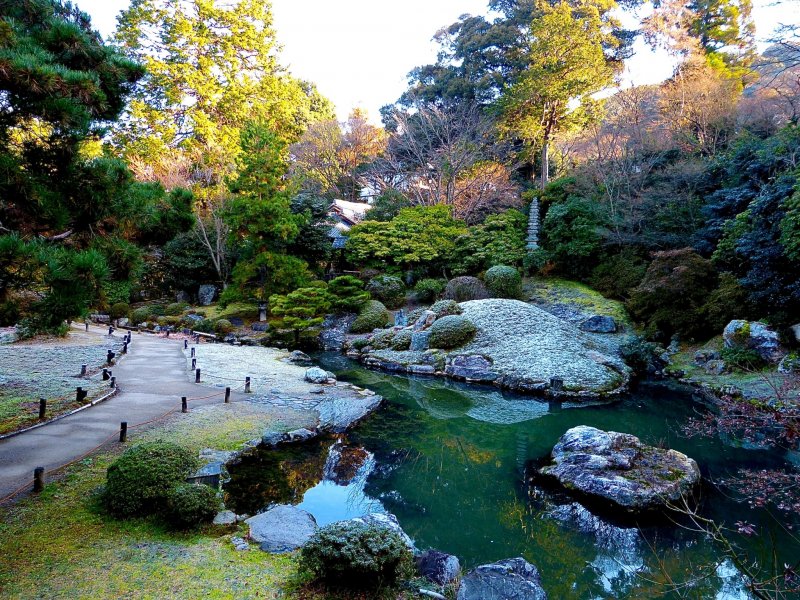
Shoren-in temple according to Wikipedia:
Shōren-in (青蓮院) is a Buddhist temple in Kyoto, Japan. Also known as the Awata Palace, it was built in the late 13th century. Shinran Shonin, the founder of the Jodo Shinshu pure land sect, was ordained a monk at Shōren-in at the age of nine.
Shōren-in was formerly the temple of the imperial abbot of the Tendai headquarters on Mount Hiei; the abbot was required to be chosen from the imperial family or high court aristocracy. After the Great Kyoto Fire of 1788, it was used as a temporary imperial palace. The main hall was rebuilt in 1895.
The temple complex contains a garden with massive eight-hundred-year-old camphor trees (kusunoki), and a pond filled with large stones and fed by a small waterfall.
Chion-in temple: Wikipedia says that it is ” the headquarters of the Jōdo-shū (Pure Land Sect) founded by Hōnen (1133–1212), who proclaimed that sentient beings are reborn in Amida Buddha’s Western Paradise (Pure Land) by reciting the nembutsu, Amida Buddha’s name. The vast compounds of Chion-in include the site where Hōnen settled to disseminate his teachings and the site where he died.”

If you have more than 3 days:
- You can do the things on the itinerary above more leisurely and stretch over longer period. Kyoto is more for slow browsing and tasting, not rushing, in my mind.
- You can easily spend a whole day in Arashiyama, the very first stop of this itinerary. There are boat rides and river walks and, of course, temples. Tenryuji Temple is right where the bamboo grove is. On the way back, you can stop at Ninna-ji and Ryoan-ji. By now you might have guessed that “ji” means a temple.
- Hotels in Ogoto Hot Springs (onsen) seem to offer attractive over night packages (one example) that include lake view rooms, dinner & breakfast. Meals at onsen lodgings are known to be excellent through out Japan. Not necessarily cheap (would easily be upwards of $150 per person), this would be an easy way to experience Japanese onsen culture.
- There are castles and imperial palaces and gardens around Kyoto. Fushimi Momoyama Castle to the south of the city can be visited any time, but other imperial compounds such as Kyoto Imperial Palace in the center or Katsura Imperial Villa to the west require a reservation which you can get online before arriving in Japan.

Getting In:
We arrived in Kyoto from Osaka on a tour bus, so our own experience would not be much help to others. But the two cities are only 40 miles apart, thus, you can get from one to the other in under an hour by train (under $6). From Tokyo, you can get to Kyoto in 2 hours and 20 minutes by the bullet train ($130).
Go to Kyoto and spend at least 3-4 days – that’s what I’d do.
trip route: LAX -> Shanghai -> Suzhou -> Wuxi -> Hangzhou -> Shanghai (Zhujiajiao) -> Osaka -> Nara-> Kyoto -> Mt. Fuji -> Yokohama -> Tokyo -> Seoul -> Beijing -> LAX
 Small Wide World
2 thoughts on “Kyoto (Japan): 2 Full Days”
Comments are closed.