June 2020

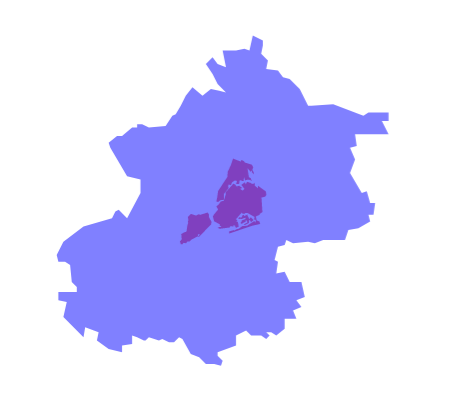
Beijing. It is the biggest capital in the world with Over 21 million people. (Only 58 out of 235 countries around the globe have population over 21 million.) It’s been a capital for over 1,000 years. How big is the area? The purple is NYC and the blue is Beijing in the map below. A lot to see and do? You can say that. So how many days should you plan to spend in Beijing to get a sense of the place? I’d say at least 3 full days – which means 4 nights.
The first thing you need to get familiar with is the concept of the Ring Roads. The location of a place is explained in relation to the Ring Roads in Beijing. The red star in the middle is Forbidden City where the Chinese emperors used to live, and the palace ground surrounded by a moat on 4 sides is the First Ring. Then the first red square is the Second Ring (2 Huan 二环 in Chinese) so on and so forth up to 5th Ring on this map below. (It actually goes out to 7th Ring.)

Most touristy things are within 4th Ring (8 km/5 mile radius from the Palace) except Summer Palace and the Great Wall. When we first started going to Beijing around 2002, there were more bicycles than cars in the city, and you could get to and from one place to another within 4th Ring in under 20 minutes by using a cab (under $4). By the end of 2009, Beijing was adding more than 1,500 new cars per day, and this brought traffic jams and smog. This means potentially spending a lot of time stuck in traffic for visitors. So choosing where to stay takes some consideration.

I’d recommend staying close to the east or north side of Second Ring as first time visitors. This way you can come back to rest if needed during the day if the schedule gets too hectic as you follow the itinerary on the map below.
One thing you have to remember: Chinese taxi drivers rarely understand English. Have someone write down that day’s destinations in Chinese characters every morning so that you can show it to the cab driver or passersby if you get lost. And make sure to keep the business card of the hotel that shows the address in Chinese characters (or ask your host to write down the address in Chinese characters for you) in your wallet or pocket . I will try to include the place names in Chinese characters in the itinerary, too. Does this mean you will use a cab a lot? I still think that is the best way for a tourist to get around. The subway is efficient, but it involves extra walking and confusion (which exit etc.). We love to get on the bus and just go around the city, but that’s for later not in your first visit.

Another thing you will have to get used to: crowds. Now that domestic travelers have taken over all the tourist attractions, there will be lots and lots of people everywhere you go.
Day 1: Center & Southwest
Go to Tiananmen Square (天安门广场), look around the enormous square, and enter through Tiananmen gate into the Forbidden City (紫禁城), which now is Palace (故宫) Museum. It will be best to buy the tickets (around $6-10) online beforehand. You are starting from south of the complex, walk almost 1 km (961 m) plus side steps to look around, and exiting through the north gate. It will be good to have the official audio guide, available in multiple languages including the one by Roger Moore in English. You can spend hours here or you can walk though in 20 minutes. In my opinion, take 60-90 minutes to walk slowly and follow the audio. There will be so much other things to see in the city!
As you exit, go across the street and climb up the hill in the middle of Jingshan Park (景山公园) to have the best view of the Forbidden City under your feet.
Catch a taxi and go to the Capital Museum (free), 5-10 minutes southwest from the park to learn a bit about the history of China through art.

By now you should be hungry, and you should have Peking Duck at the oldest duck restaurant in the city, Bianyifang (600 years old but not at the same spot). We usually order half a duck plus a couple other vegetable dishes for the two of us at these duck restaurants.
After lunch, walk a few steps to check out the Undergroud City (地下城), an extensive old bomb shelter that holds a lot of mysteries, and see whether it’s open. It was mildly interesting when we saw a small section of it, but since then some articles came out in the West claiming as many as over a million people lived there in a not-so-desirable condition, and the government is not eager to show it to tourists. After all, it is a part of life in this city, though.
Grab a cab to the Silk Street Market (秀水街) where you will find knock-off brand name merchandises and silk and other souvenirs. It used to be a street market, but it is housed in a big building now.

You can’t talk about China without talking about tea. So next you get on yet another cab and go to Maliandao Tea Street (马连道路 茶叶街). You can find a huge range of teas from bargain priced to too precious to sell, go into a shop and sample some, admire beautiful tea wares etc.
A short cab ride will take you to Liulichang (琉璃厂), a street of traditional Chinese art since 1600’s. It’s become a bit too touristy to my taste, but it still shows its own character. There are many hutongs to peak in around here. It’s close to our dinner and evening spot, Lao She Tea House (老舍 茶馆) where you get a one stop service of a dinner, tea, and a variety show of Chinese tradition.
If you still have energy, cab or walk to Wangfujing Pedestrian Street, a commercial street since 1300’s, and stroll around. More modern than you expect, but there’s a snack street, and there tend to be a lot of stuff going on in the evening.
Day 2: Center & Northwest
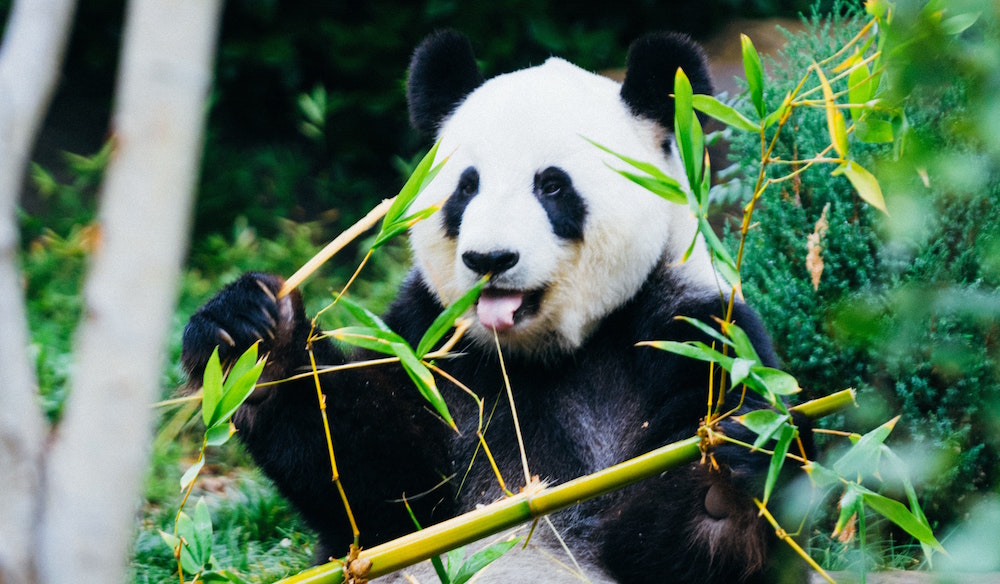
If panda is your thing, go to Beijing Zoo (北京动物园) first thing in the morning (opens at 7:30 AM) when these creatures are more active. Once they are fed, they tend to sleep a lot. Sleeping pandas are cute, some say, but we found them not as interesting. The Zoo has other things, but you have other things to do, too. That’s probably why they put the panda section right by the entrance.

Cab to the Summer Palace (颐和园) & see how the Chinese emperors wanted their gardens to be. You will immediately know they wanted it to be big. Buy tickets online in advance to avoid the line. (if this link doesn’t work on your phone, try to copy this address: http://www.summerpalace-china.com and look for the information )
Next to this huge complex is another garden known as the Old Summer Palace (Yuanmingyuan 圆明园), an older royal garden. This is not as popular among the tourists, thus, you can make a quick stop if you want to see the garden once known as the ‘Versailles of the East’ most of it now in ruins due to destructive foreign forces.

Lunch will be at a courtyard restaurant Bai Jia Dayuan (白家大院) to eat like an emperor for one meal. Frankly, we have not been there because there are too many great restaurants in Beijing that our local friends wanted to take us to & we are, in general, too cheap to splurge on a meal like this. But, as a tourist, this can be a worthwhile experience and you wouldn’t order as much food for lunch.

A taxi can take you quickly to the Bird’s Nest, the National Stadium (北京国家体育场) of China, the site of 2008 Summer Olympics, for a photo op. The Water Cube swimming center is right next to it.
Another quick cab ride will get you to the Lama Temple (Yonghegong 雍和宫) to have a glimpse of Tibetan Buddhist artifacts and structures.

A few hundred meters down on the other side of the street lies Temple of Confucius (北京孔庙), the second largest Confucian temple in China, after the one in Confucius‘s hometown.
Now go to Houhai Lake (后海) for a leisurely stroll. The cab driver may ask you where you want to go at the lake since it is not a small lake, then you show him the map on this site and point to it. There’s a lot going on around here with bars, restaurants, cafes, parks, boat rides etc., but you may not have a lot of energy by now. So just walk along the north shore of the lake so that you can be closer to the dinner spot. You will see Chinese families and young couples having a good time along with tons of tourists.

Dinner will be at a modern Chinese restaurant at a hotel on a hutong: Furongji at the Orchid Hotel (address: 宝钞胡同63号). This is another popular hutong area in Beijing.
Now time to relax. Really relax. Get a cab and head to Bodhi Therapeutic Retreat for a Chinese massage. Call earlier in the day to make a reservation. Yes, they speak English.

Day 3: Great Wall & Northeast
Today you will go to the longest (2½ km, 1½ miles) fully-restored Great Wall section open to tourists, Mutianyu (慕田峪). It is 70 km (43 miles) northeast of Beijing, and you should hire a cab ($27 – 35 each way) to get there in 60-90 minutes. If you are with more than 4 other people, you may want to consider hiring a van/driver. Ask your hotel to arrange it. $150 for the day would be a fair price. Or try this site which we used in other countries (worked well) but not yet in Beijing.

We like Mutianyu better than Badaling, the most popular section closer to town. It is not as crowded and is more fun because you can use the cable cars to go up and take the slideway down (5 minutes). There are 3 watchtowers to climb in and look out, too. We usually spend a couple of hours walking on the wall.

There are many restaurants within the park mostly between the ticket office and the cable car station. We saw this restaurant in the picture above after we ate our lunch. We should remember to try it next time.

On the way back, we will go to 798 Art District (798 艺术区 a.k.a. Dashanzi Art District 大山子 ) to witness the thriving art scene in Beijing. It is a huge old military factory complex that has been turned into an art zone, and you can spend hours browsing among hundreds of galleries, cafes, restaurants, shops etc. Even if you are not an art lover, you will get a kick out of visiting this hipster/artsy area. Beijing has other interesting art venues, but you don’t have enough time for that now.

Dinner tonight: Haidilao Hot Pot (海底捞) is one of the popular hot pot restaurants in Beijing. “All diners at Haidilao are entitled to free fruit salad, ice water, shoe shining and nail care, melon seeds, and guests might play cards or chess when they wait.” How do you beat that?

If you are up for another evening show, try Chaoyang Theater (朝阳剧场). Not necessarily cheap for Chinese standard ($37-117), it is a well produced acrobatic show. Buying tickets in advance online will save money.

Getting in: Getting from Beijing Capital Airport to north or east side of the Second Ring Road will normally take 20-30 minutes by taxi and cost never more than $20 unless there’s a horrendous traffic. All taxis are metered, and make sure the driver turns the meter on. Most of them do, but some might try otherwise.
When you are heading out to the airport, the taxi driver will want to know which terminal you want to go to – terminal 2 or 3 (terminal 1 is domestic only). These two terminals are not close to each other, thus, it will be good for you to find out in advance which terminal your flight is leaving from.
Getting Around: Beijing has an efficient subway system and cheap (1-2 yuan) buses. But for the first time visitors, it is not easy to figure our where to catch what and come out through which exit etc. Cabs are cheap, and, even with the traffic, it will be easier to do the trips mentioned on the itinerary by taxi.

Stay: If you need your room to meet certain international standards in comfort and cleanliness, you should stick with international brands – the usual top end ones plus Holiday Inn, Howard Johnson, Days Inn etc. Local hotels vary quite a bit in quality even when they have the same star rating. Most 4-5 star hotels are fine for the most part, though.
We used to have fun trying out different types of local hotels in all parts of Beijing. There could be certain quirkiness with each arrangement such as:
- traditional courtyard hotels: we experienced super hard mattresses at times
- serviced apartments: kitchen space was there but not set up to cook
- claiming to be “super luxurious” hotels: fancy looking but not very well maintained interiors
- “boutique” hotels of all sorts: the room was a bit too tight or too cute (cartoon characters, anyone?) at times
But, these days, we just stick with places that have good reviews and clear photos & are close to where our friends live. We usually find decent deals by searching on skyscanner.com or on a Chinese site trip.com for Beijing. We have had mixed results on Airbnb in China mainly due to miscommunication (unexplained cancellations, no clear directions, slow responses etc.). When it worked, the quality was quite satisfactory in general.
– last time we were in Beijing was in November 2019
 Small Wide World