April 2018

A major port city on the northern island of Hokkaido, Hakodate(population: 265,000) meant fresh sea food to me. I was ready to march in and have the freshest uni(sea urchin) bowl I’ve ever had in my life.
Celebrity Millennium docked at a wharf a bit away from the center, and a free shuttle service was provided by the City to Hakodate Station. This city was ready for foreign tourists, and they had all sorts of maps and brochures to give away at the tourist information center at the station.


Right next to the Station is Hakodate Morning Market, a sea food market filled with stalls of right-off-the-boat fish and crabs and oysters. And restaurants. Almost all the restaurants had at least one form of uni bowl on their menu, but they were, like, $15-$50 per bowl. These bowls were not big, and, there were lines at the popular ones. (Who wants to go to an unpopular restaurant!) Pat asked me, “Do you really want it that badly?” I thought about it and said no. It was before 10 AM, and we had a good breakfast on the ship. The word ‘cheap’ never entered my mind as we looked at the price tags attached to fresh sea food items displayed at this market.

Hakodate was the first port opened in Japan to foreign traders in 1854, thus, this city has historic significance in Japanese history. The City zeros in on this fact in tourist development effort, and they have well marked signs all over the city to let the visitors know. Hakodate has basically 5 different areas to visit, and these are well connected by public transportation. We bought a day pass(about $6) for the tram system at the tourist information center and went to 4 of the 5 areas.

The first off after the morning market: more cherry blossom trees. Every brochure about Hakodate shows a star shaped park filled with pink cherry blossoms, and this is Giryokaku Park. The park was about a 15-20 minute walk from the tram stop, and many people from the tram were heading that way. So we just followed. The park was free to enter (pay to get up to the tower), and there were lots of families and groups picnicking on the ground. Quite nice, but we thought Hirosaki was much more impressive.


We got back on the tram and went to Yunokawa hot springs area. Getting off at the second to the last stop, Yunokawa Onsen, we found the free outdoor foot bath where we soaked our feet that were tired by cherry blossom chasing. From there, we strolled along the small river to reach the ocean passing by several different hot springs resorts.
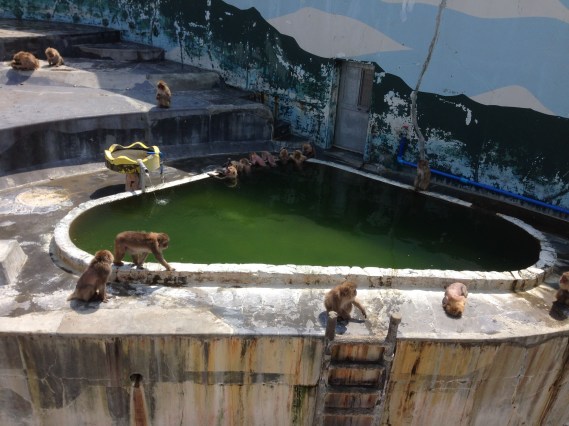
Turning left when we reached the ocean, we got to Hakodate Tropical Botanical Garden where monkeys were swimming in the hot springs water. We were not clear why a tropical garden happened to be there, but it was mildly interesting. We were not too sure about the monkeys, though. They looked bored and lethargic.
I had missed a shrimp soba noodle in Aomori the day before, and I had to pass on the uni bowl earlier in the day. I deserve a good sushi lunch, I declared. My careful research had directed me to a restaurant called “Sushi Tokoro Kihara” not far from the Tropical Garden right on the ocean’s edge. I know that link takes you to their website which is all in Japanese. We couldn’t eat there because we had no reservation, and a lady said in very polite English, “can you come back in 2 hours?” If you want to go there with a reservation and want the contact information, well, here it is.
Fortunately, there was another restaurant next to it that seemed popular. We stepped in, and they were able to find two stools for us at the counter. It was a ramen place. We were not huge fans of ramen noodles, but what could we do. We were ready to eat anything. Well, it was the best bowl of ramen we ever had. In fact, we may not have another one like that unless we go back to that area of Japan. The broth had complex, deep taste, and the noodle was cooked just right. We only know ramen as a convenient instant food, but people of Hokkaido take ramen very seriously. Yum! I want it right now!

We took the tram back to the Bay Area where old warehouses were converted into hipster shopping/eating/drinking halls. We could also walk to the historic Motomachi area with early western influenced churches and buildings, but we were happy to have just a little glimpse of it. We skipped the Hakodate Mountain and cable car area entirely. No energy.
 Small Wide World