June 2017


St. Petersburg, the bustling Cultural town of 5 million people sitting on the Neva River, was founded by and named after Peter the Great, a great reformer who led Russia to be the major European power.
Our tour of St. Petersburg started in Peterhof Palace, commonly known as the Russian Versailles. We were on Royal Caribbean Vision of the Seas cruise and stopped in St. Petersburg for 2 nights. We hired a local tour guide found online, Alisa, and she picked us up from the port. Alisa was very professional and punctual, and she really knew and understood the history and culture of her city. She quoted a very reasonable rate – about $105 per person for the all-day private tour for our group of 4 in a private van/driver. She provided the paperwork for one of the friends who did not have the Russian visa. (Cruise passengers were not required to have a visa, but they had to go with a licensed local tour company in order to be off the ship.)
We left the port around 8:30 in the morning and arrived at Peterhof a bit after 9:30 — early enough to beat the crowd. Alisa knew all the historically meaningful and photogenic spots. The most impressive and memorable were the fountains throughout the park, and each had a story to go with. We heard a lot about how Peter the Great admired Germany and other European countries and cultures, and he opened the eyes of Russian people who tended to be more tradition-bound.
She led us to a restaurant by the park entrance that was reasonably priced and helped us with sampling Russian dumplings and other dishes.
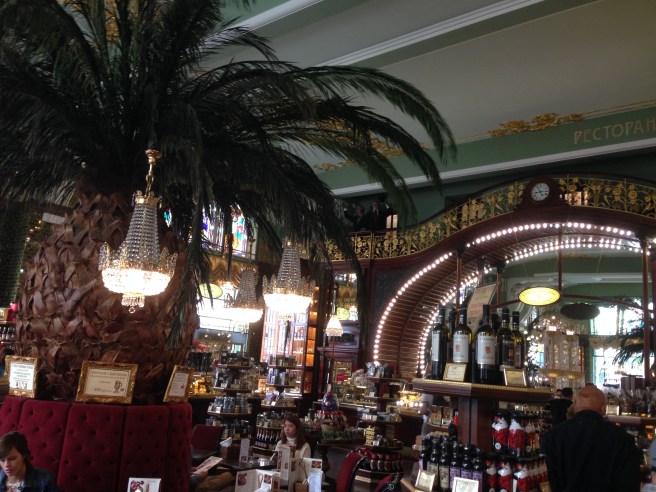
We drove back into the city center, parked the van, and walked a few blocks to see some monuments and famous buildings. She took us to this chocolate shop on their main drag, Nevsky Prospekt, that had a huge collection of handmade chocolates and candies. The shoes and the fruits below are all edible.


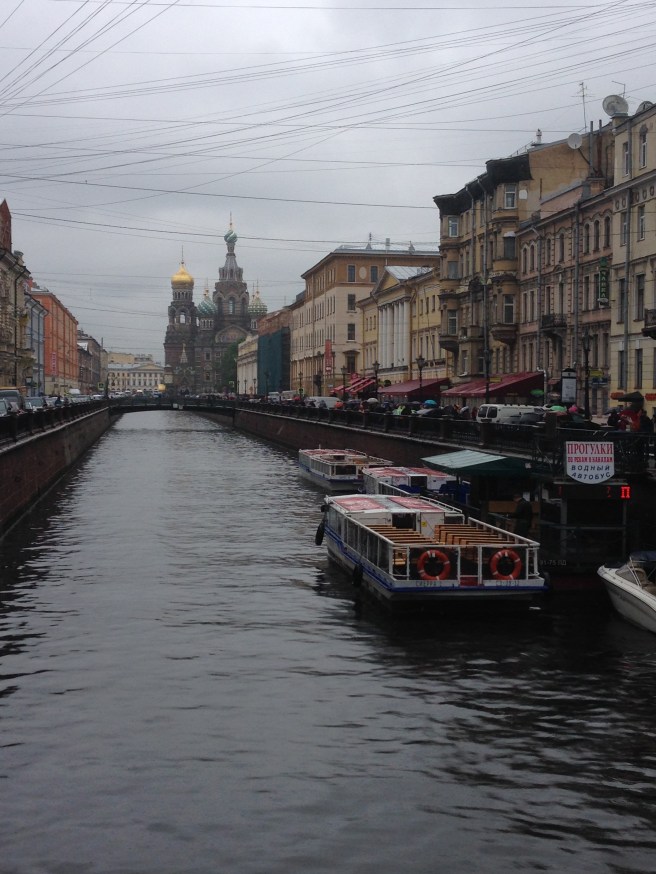
Next stop was the Savior on Spilled blood church above, and we went to St Isaac’s Cathedral below after that. By this time, every attraction in town was filled up with tourists. We felt lucky coming out still alive!


An excerpt from a description of Neva River, pictured below:
“The Neva is the main waterway of Petersburg and the town is situated along its banks and across the islands of its broad delta. It is one of the largest rivers in Europe by volume of water and also one of the world’s shortest major rivers at only 74 kilometers. The Neva connects Lake Ladoga, the largest lake in Europe, to the Baltic Sea. For centuries, it was of great strategic importance for transport and so the interests of the Russians, Swedes, Finns, and Balts clashed on its banks. From the 8th-13th centuries, the Neva was part of the trade route from Scandinavia to Byzantium, the road “from the Varangians to the Greeks.” In 1240, the Novgorod militia led by Prince Alexander Yaroslavich defeated the invading Swedish army on the banks of the Neva. Because of the victory, the prince was thereafter nicknamed Alexander Nevsky (of the Neva). But the main page in the history of this great river began to be written, of course, in 1703 when St. Petersburg was founded at the mouth of the Neva.”
Read More on saint-petersburg.com: continue
We were on our own on the second day of our stay in St. Petersburg. This day we ventured out into town with two other friends who did not have a visa issue. We took the bus from the port to a metro station, then we started our tour of the metro stations. It is said that the Soviet government built these beautiful stations basically to show off. Well, that worked! It is very hard not to be impressed by each distinctive, beautiful or intriguing interior design applied to such mundanely routine place of utility.
Here’s the link to the Metro map and the tickets information.
Next, we went to the real holder of ascetic beauty, the Hermitage Museum. We wisely bought our tickets online way before our arrival in town, and we were ecstatic as we walked by the long ticket line and went to the ticket pick up office only foresighted people like us were allowed in.
When you walk into the Louvre in Paris or the Met in NYC, you know and feel that you are walking into a museum. At Hermitage, I felt I was visiting someone’s living room, well, a very big one, I might add. I could maintain this feeling till busloads of tourists arrived from the biggest nation in the world and filled every inch of the museum after an hour or so of leisurely viewing. Maybe it was worse because of the pouring rain, and the tour companies had to divert their guests into indoors. Maybe not.
Getting out was not a simple task while people were blocking all the stairs and doors. When we finally found all four of us outside the pale green buildings, we felt liberated. Rain or not. We were quite happy when we finally ducked into a restaurant on Nevski Prospekt, and we all had to order an alcoholic drink.
We will have to come back when there are not as many tourists. Maybe in winter?
 Small Wide World