January 2016 Itinerary Link

To visit Colca Canyon from Arequipa, we joined a group tour offered by a local agency, Giardino Tours. They charged $126.50 per person for the transportation(from Arequipa to Colca, then onto Lake Titicaca area) and an English speaking guide and a night at a hotel.
This is what they promised & delivered:
FIRST DAY
We will depart at 7:30 am from Arequipa, driving 160 km to the town of Chivay, capital of the Province of Caylloma. At the beginning of our excursion, we will enjoy the majestic views of the Misti, Chachani and PichuPichu volcanoes before approaching the National Reserve of “Pampa Cañahuas”, where our transportation will make a short stop to observe the wild Vicuñas (one of the 4 types of American camels) in its natural habitat. At this point, we will be about 3,400 meters above sea level. Moving on we will arrive to “Pata Wasi” (Pata=high Wasi=home), an Andean community at the opposite border of the reserve.
Here you might enjoy the natural formation of rocks and the view to the backside of the Misti and Chachani volcanoes. To prevent altitude sickness we will have an original Andean “Mate de Coca” drink or another hot drink in a rustic restaurant on the road (service of bathrooms are here available).
Continuing on the road we will pass “Tocra”, a high plain at more than 4,500 meters, where we will observe lakes with migrant birds and get pictures of the “Altiplano” with its Llamas and Guanacos. The highest point of our tour will be “Pata Pampa” (Pata=high, Pampa=land) located at 4,820 meters, where we’ll observe the volcanoes Ampato, Sabancaya, Hualca-Hualca, Mismi (the source of the Amazon River), and the “Cordillera de Chila”. When we are getting close to the town of Chivay (3,651 meters) we will start to wonder at the spectacular multicolor view of the terraces of the Colca valley.
We keep our drive until Coporaque town and visit the Lodge La Casa de Mamayacchi, where we will have our lunch (cost of lunch is not included in the program).
After lunch, your guide will invite you to a short walk through Coporaque and its surroundings (this walk takes around 1 hour and is optional)
We’ll come back to our transportation and visit a natural “hot springs”, where we will enjoy a relaxing bath (entrance fee and personal towels to the baths are not included).
After this exciting day, we will bring you to your hotel, La Casa de Mamayacchi.
The hotel was owned by the tour company, and it was a very comfortable hotel. The dinner there was quite good and reasonably priced. Pat bought an alpaca poncho at the market in Chivay, and $20 dollar price was the best we had seen in Peru.
SECOND DAY
We will have our breakfast very early in the morning and leave to the famous “Cruz del Condor” point. Arrive to “Cruz del Condor” and time enough to have an enjoyable view of the deep of the Canyon and if the weather permits; majestic pictures of the flight of the Condors. After a coordinated time, our guide will take you for a short walk near the Canyon (1-hour approx.) On the way back to Chivay we’re going to visit the traditional village of Pinchollo and the “Antahuilque viewpoint”, where wonderful 1,500-year-old terraces, constructed by the Collaguas, a culture well before the Incas’ time, can be observed. We also will make a stop at the look-out point of “Choquetico” with its hanging tombs “Tumbas colgantes“, and take a look to the litomaqueta, a model of the canyon terraces carved in a rock. We will continue visiting Maca, an Andean community that experienced an earthquake in November of 1991 and the village of Yanque with the most beautiful church in the valley.
Approx. 13:30 transfer to Puno city on Lake Titicaca
We did spot a couple of condors way high up, and we didn’t bother to take pictures which would have come out as dots in the sky.

We had this mysterious drink at lunch.
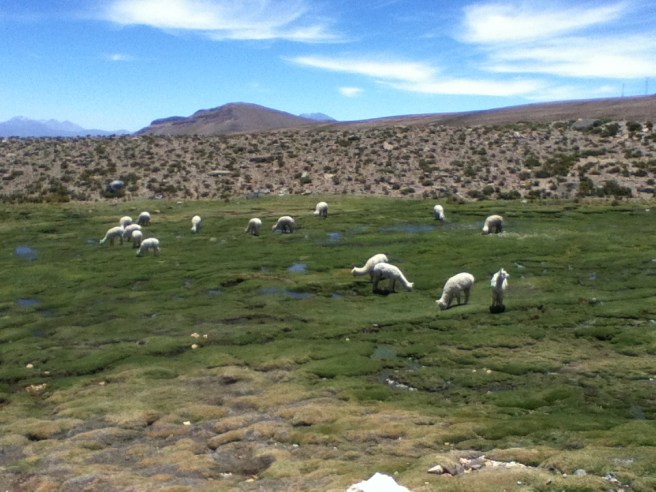
This is a typical scenery you encounter on the way to Titicaca. We also felt the rising altitude and had a mild headache.
We spent three nights in Puno(population: 140,000). The first night was at an Airbnb apartment which was too cold at night. The host was very nice, though, and he arranged for a tour($40) of the lake that included spending a night with a local family on one of the islands. We booked a hotel($55) for the third night, and we were able to leave our bags there before we went on our trip the next day.
At 3,812 meters (12,507 ft) from the sea level, Lake Titicaca is supposed to be the highest navigable lake in the world. I continued to have a mild headache, and taking pills bought at a local pharmacy helped.
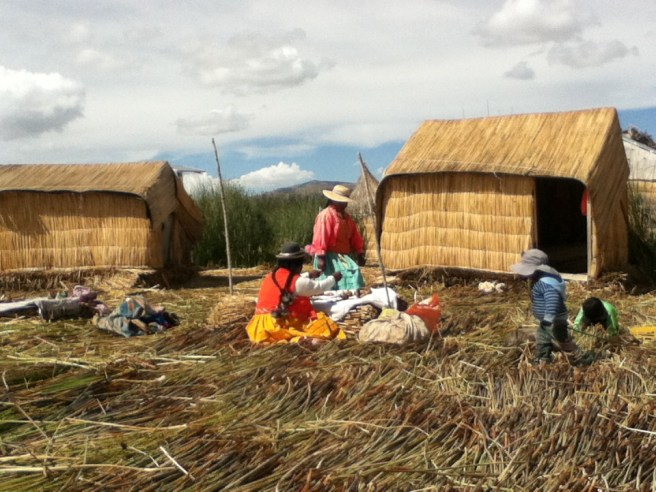
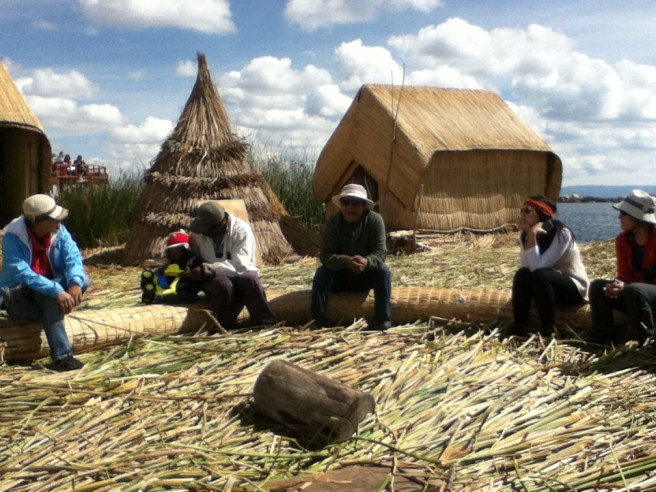
The ever famous floating islands are tiny man-made islands constructed by the Uros people using layers of buoyant reeds called totora. We visited a couple of different ones and talked to the family members.
Then we took a boat to get to Amantani island where 4,000 people lived. Each person in our tour group was matched with a local family, and we ended up with the people whose house was on top of one of the hills. We were served dinner in their kitchen, and we tried to talk to them, but they did not speak much English. Lots of smiles and gestures filled the void. The room was with a proper bed, and that was a luxury! The bathroom was in the yard and had a toilet seat. Water had to be poured in manually. We had seen people carrying big buckets of water up the hill on their back, and this made us reluctant to waste the water. We tried to keep the bathroom use at the minimum.
When we returned to Puno, it felt good to be in a modern hotel which was right in the middle of downtown. We walked around to see whatever was there to see.
One restaurant we tried and liked was called Mosja located in front of the Cathedral. The restaurant at the hotel we stayed at, Hacienda, wasn’t bad.
 Small Wide World